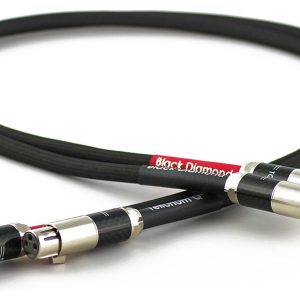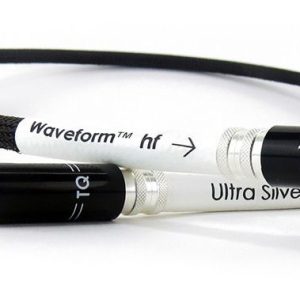
Chord Signature Digital Super ARAY RCA Digital Audio Cable
930,00 €
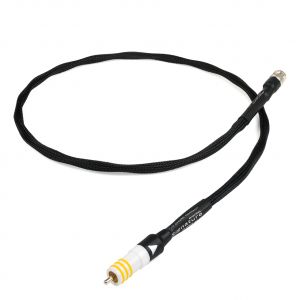
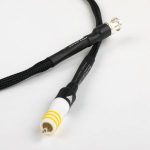
Chord Signature Digital Super ARAY RCA is a 1 m coaxial digital audio cable for connecting a digital source to a converter through RCA connections. Two 75-ohm silver-plated oxygen-free copper conductors have PTFE insulation, while a silver-plated braid and foil provide shielding. The more flexible ARAY construction helps with routing between components on a shelf while leaving slack at the connectors.
Chord Signature Digital Super ARAY RCA is a 1 m coaxial digital audio cable for connecting a digital audio source to a digital-to-analog converter. This version has RCA connectors at both ends. It suits a system in which the source sends a digital signal through a coaxial RCA output and the converter receives it through a corresponding input. You can use it when listening to CD-quality recordings or playing high-resolution audio files. In either case, the connections on the equipment determine whether this RCA version is the right one.
Choosing the right connections
An RCA socket’s shape alone does not tell you what signal it carries. Before connecting the cable, identify the coaxial digital output on your source and the matching digital input on your converter. Check the labels beside the sockets rather than assuming that any RCA pair will serve the same purpose. Analog left- and right-channel RCA connections call for a cable intended for analog audio.
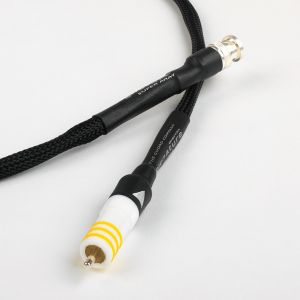
The connector type matters at both ends of the run. If either device uses a BNC socket, the RCA connector on this version will not fit it. The same RCA version is not intended for an AES/EBU connection. Separate cable versions are offered for those connections, so check the sockets on both devices before choosing a version. This is especially useful when a system has several types of input close together on a rear panel.
Conductors and connector construction
The cable uses Super ARAY conductor geometry. Its two silver-plated oxygen-free copper conductors have PTFE insulation, and each conductor is specified as 75 ohms. For a coaxial digital connection, that specification helps distinguish this cable from an analog RCA cable that may look similar from the outside. The presence of RCA plugs does not, by itself, establish what a cable is designed to carry.
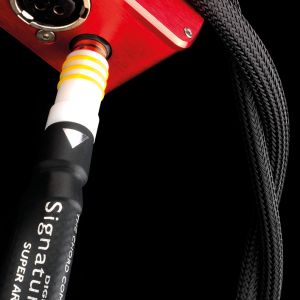
Low-mass RCA connectors are silver-plated and have precision-machined PTFE surrounds. When making or removing a connection, hold the connector body rather than pulling on the cable. This also gives you better control when guiding a plug straight into a socket, particularly where a shelf or the back of an adjacent component leaves little room for your hand. Check that you can reach the sockets without putting the cable under tension.
Shielding and placement
Shielding consists of a dense silver-plated braid and foil. Together, these are intended to shield the digital signal cable from high-frequency interference. The cable also has compression-free strain relief at the connector. When arranging the equipment, leave enough slack that the cable does not pull on either socket. The strain-relief construction is part of the connector area; it does not remove the need to allow space behind the components.
This version is 1 m long. Measure the route between the rear connections before deciding where to place the source and converter. Include the space the cable needs behind each device, as well as a little slack at both ends, rather than measuring only the gap between their cases. The updated, more flexible ARAY construction makes the cable easier to route when components are placed on a shelf. If a 1 m run cannot reach both sockets with slack to spare, a custom-length version is available.
Place in the audio system
This cable provides one coaxial digital audio connection between a source output and a suitable input. It can be used in a home cinema system where the devices have the matching coaxial RCA connections, just as it can connect a digital source to a converter in a music system. It does not provide multiple connections for several sources. This model replaces the earlier Signature Tuned ARAY digital cable.
Technical specifications
| Type | Coaxial digital audio cable |
|---|---|
| Version | RCA |
| Length | 1 m; custom lengths available |
| Conductor geometry | Super ARAY; updated, more flexible construction |
| Conductors | Two 75-ohm silver-plated oxygen-free copper conductors |
| Conductor insulation | PTFE |
| Connectors | Low-mass silver-plated RCA connectors |
| Connector surrounds | Precision-machined PTFE |
| Shielding | Dense silver-plated braid and foil |
| Strain relief | Compression-free |
FAQ
How can I tell a digital RCA connection from an analog one?
Read the label beside the socket on each device. This cable needs a coaxial digital output on the source and a corresponding input on the converter. Analog left- and right-channel sockets have a different function, even though they also use RCA connectors.
Is this cable intended to connect a player directly to an amplifier?
It is intended for a digital connection to a device with a coaxial RCA input. If the amplifier has only analog RCA inputs, a digital-to-analog converter is needed between those inputs and the digital source.
Will 1 m be enough for components on a shelf?
Measure the route between the rear sockets, not just the distance between the component cases. Allow room for the cable behind the equipment and a little slack near both connectors. Choose a custom length if the 1 m version cannot make that route without tension.
Can I plug this RCA version into a BNC socket?
No. This version has RCA connectors at both ends. If the source or converter uses a BNC socket, choose the separate version intended for that connection.
Is the cable suitable for CD-quality recordings?
Yes. It is intended for the digital connection between a source and a converter when listening to CD-quality recordings or playing high-resolution files. The type of recording does not change the need for matching coaxial RCA connections.
Can it be used in a home cinema system?
Yes, for a digital audio connection where the devices have a matching coaxial RCA output and input. One cable serves one such connection.
Can one cable connect several sources?
No. This cable connects one source output to one input. Each additional direct connection needs its own cable and an available input.
Related products and categories
Related products