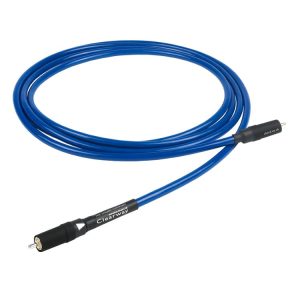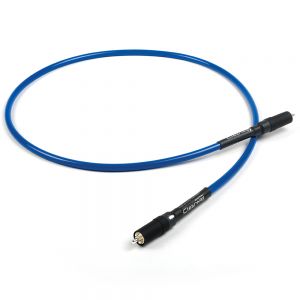
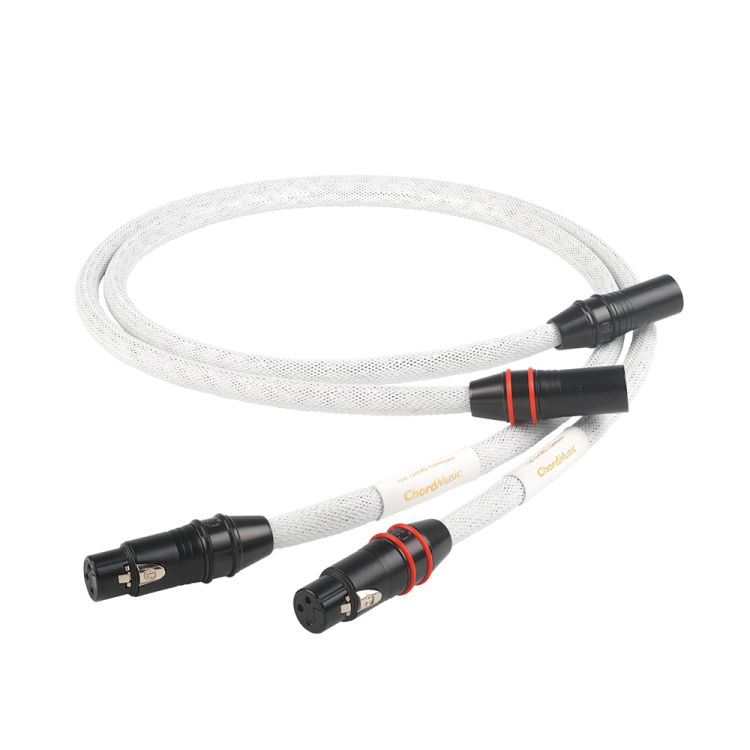
Chord ChordMusic Analogue XLR Analogue Interconnect Cable
7 200,00 €
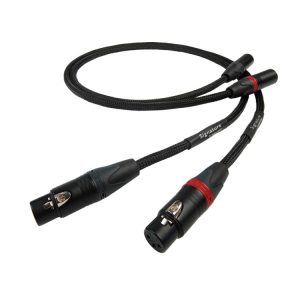
Chord ChordMusic Analogue XLR is an analogue XLR interconnect cable for audio equipment with corresponding analogue XLR sockets. Phase-stable Taylon® insulation and Super ARAY geometry are its key construction features. If your equipment also has RCA connections, compare both connection methods at the same listening volume to determine which is better suited to your particular system.
Chord ChordMusic Analogue XLR is an analogue XLR interconnect cable designed to carry an analogue audio signal between compatible devices with XLR outputs and inputs. Its construction combines Taylon® insulation with Super ARAY geometry.
This model is worth considering for a system in which a source, preamplifier or power amplifier is connected through analogue XLR sockets. It is not a speaker cable and must not be connected to amplifier speaker outputs or loudspeaker terminals.
Construction and insulation
Taylon® is an insulation material developed by Chord. It was designed as an improvement on the widely used PTFE insulation found in many cable designs. Taylon® is described as a phase-stable material.
In this context, phase stability refers to a property of the insulation material. It is not a phase setting for an amplifier, processor or subwoofer. When making a connection, align the plug with the socket before inserting it and never force the connector into place.
The insulation is combined with Super ARAY cable geometry. These are the two principal construction features of this model. Together, they distinguish it from XLR cables that use conventional PTFE insulation or a different conductor geometry.
Connecting the cable to an audio system
Use the cable to connect the analogue XLR output of one device to the analogue XLR input of another. For example, it may be used between a source component and an integrated amplifier. It can also carry a signal from a preamplifier to a power amplifier.
The physical shape of an XLR socket is not enough to determine whether this is the correct cable. The same connector format can also be used for a digital AES/EBU signal. This model is intended for analogue signals, so it should not be selected as a specialised digital cable.
An XLR connection does not, by itself, confirm any particular internal circuit topology within the equipment. Both sockets being connected must belong to the same type of analogue signal path. Do not connect an analogue output to an input marked for a different digital connection.
Choosing between XLR and RCA
If both devices provide XLR and RCA connections, you can compare the two connection methods in your own system. Use the same recording and keep the listening volume consistent. Differences in signal level can otherwise make the comparison misleading.
Switch off the connected equipment before changing cables. Compare one complete signal path first and then the other. Do not mix XLR and RCA connections within the same pair of channels being evaluated.
The most suitable choice depends on the complete equipment chain, not simply on the shape of the connector. If the preferred result is obtained through RCA, there is no requirement to use an XLR cable. An adapter is not equivalent to a direct connection between two analogue XLR sockets.
Planning cable length and routing
Before choosing a length, measure the actual route between the components. Allow a little extra cable so that the connectors remain accessible and the equipment can be pulled forward when necessary. The cable should not be left under tension or bent sharply immediately behind either connector.
Keep the signal cable apart from mains power cables whenever this is practical. If the routes must meet, it is preferable for them to cross rather than run parallel over a long distance. This helps reduce the likelihood of unwanted electrical interference.
When disconnecting the cable, hold the connector body rather than pulling on the cable itself. Check that each connector has been inserted fully when setting up the system. Careful handling reduces mechanical strain where the cable meets the connector.
Two-channel and multichannel systems
In a stereo system, the left and right channels use separate analogue signal paths. Choose the required cable quantity according to the number of channels you need to connect. Keep the channel identification consistent at both ends of the system.
In a home cinema system, this model can connect the analogue outputs of a processor to the inputs of a power amplifier. Every channel in use requires its own signal path. Before planning a multichannel installation, count only the analogue XLR channels that will actually be used.
A subwoofer equipped with an analogue XLR connection may also be connected, but only to the corresponding line-level output. Its XLR socket must be intended for an analogue low-frequency signal. A speaker-level output is not suitable for this connection.
Checks after connection
The cable has no volume, phase or frequency controls. These settings are adjusted on the connected audio equipment. Once everything is connected, begin listening at a low volume and check that both channels are operating correctly.
If one channel does not play, first confirm that the correct input has been selected and that the connectors are fully inserted. You can then swap the channels at the equipment end. This helps distinguish a cable connection issue from a setting associated with the source or amplifier.
Technical specifications
| Model | Chord ChordMusic Analogue XLR |
|---|---|
| Product type | Analogue XLR interconnect cable |
| Connector format | XLR |
| Signal application | Analogue audio signal transmission |
| Insulation material | Chord-developed Taylon® insulation material |
| Insulation property | Phase-stable |
| Insulation design objective | Designed as an improvement on PTFE insulation |
| Cable geometry | Super ARAY |
FAQ
Which devices can be used with this cable?
It connects two devices equipped with corresponding analogue XLR outputs and inputs. Typical system components include a source, preamplifier and power amplifier.
Can this cable be used to connect loudspeakers?
No. It is an analogue interconnect for carrying a signal between components, not a cable for connecting amplifier outputs to loudspeaker terminals.
Can it be used for a digital AES/EBU connection?
This model is intended for analogue signals. For a digital AES/EBU connection, choose a cable specifically designed for that type of signal.
What should I choose if my equipment has both XLR and RCA connections?
Compare both direct connection methods at the same listening volume. Choose the connection that works better with your particular combination of equipment.
How many cables are required for a stereo system?
The left and right channels need separate signal paths. The quantity ordered should therefore correspond to the number of channels you want to connect.
How should I choose the correct cable length?
Before ordering, check the length of the selected variant and compare it with the measured route between the relevant sockets.
Does anything need to be adjusted on the cable?
No. Volume, channel assignment and other parameters are set on the connected devices. The cable carries the analogue signal between the selected XLR connections.