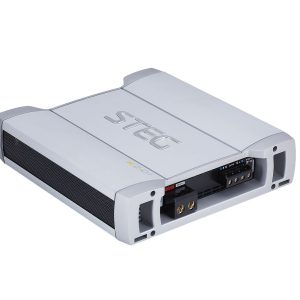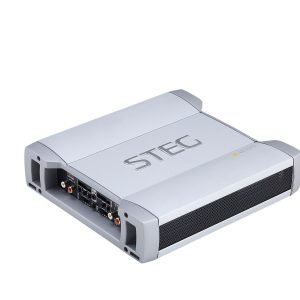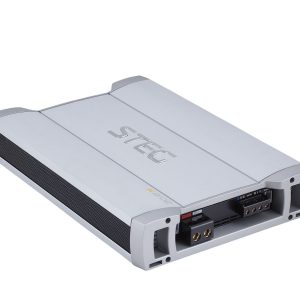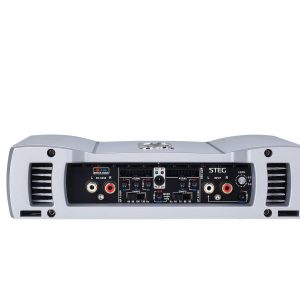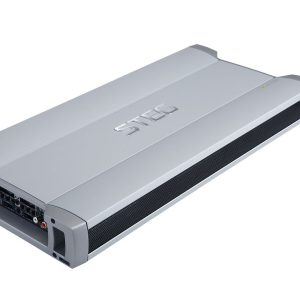
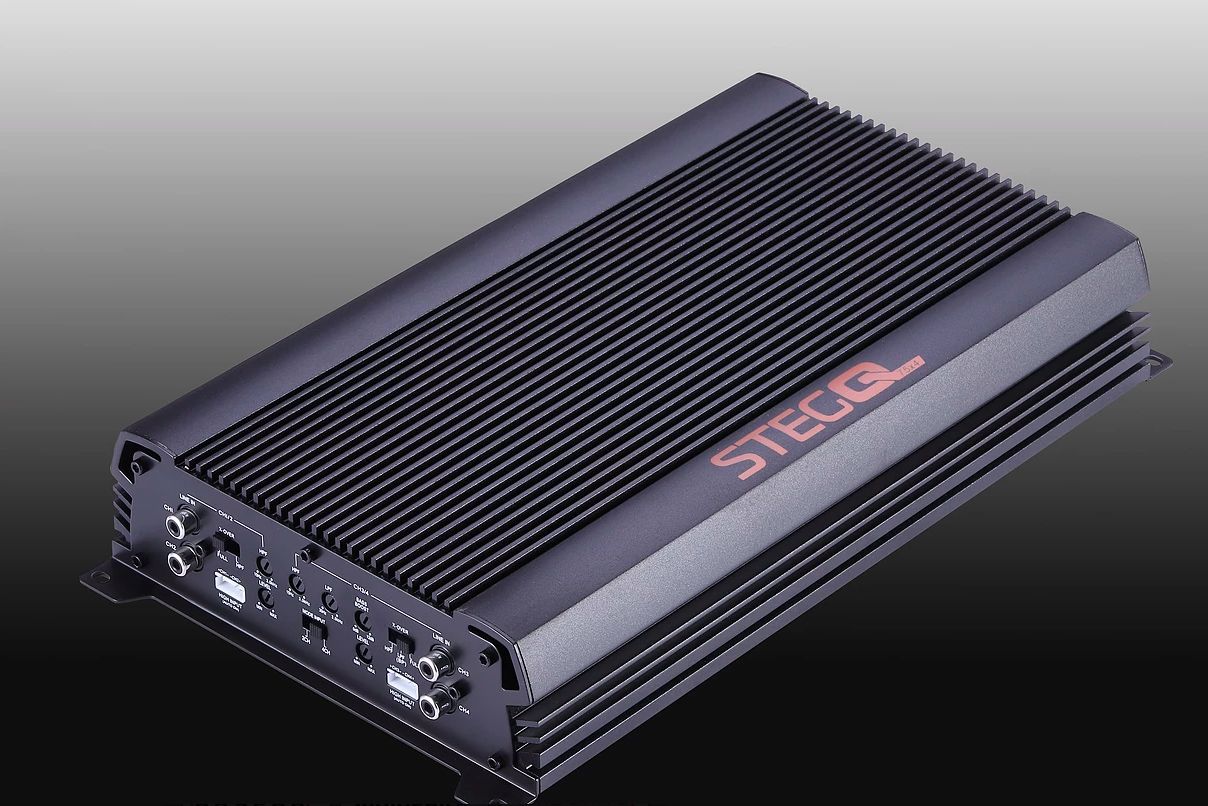
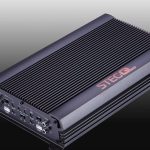
Steg QM 75.4 Amplifier
205,00 €
Steg QM 75.4 is a four-channel car audio power amplifier for a multi-speaker system or two loads powered in bridged mode. High-level inputs make connection to a factory audio source easier. Automatic signal-sensing turn-on is useful when the source does not have a separate remote turn-on output. Adjustable filters allow the frequency range sent to the connected speakers to be tailored appropriately.
Steg QM 75.4 amplifier is a four-channel car audio power amplifier designed to drive a multi-channel system. It supports 2-ohm stereo loads and 4-ohm bridged loads. Its four channels can power two pairs of speakers, while bridged operation provides two higher-power channels.
Who It Is For
Four-channel mode is suitable for powering front and rear speaker pairs. At a 4-ohm load, the specified output is 75 W RMS per channel. With a 2-ohm load, output increases to 105 W RMS per channel.
When the channels are bridged, the amplifier delivers 210 W RMS × 2 into 4-ohm loads. All power ratings apply at a 14.4 V supply voltage. When comparing this model with other amplifiers, use output figures measured under the same conditions.
Connecting It to the Car Audio System
High-level inputs accept speaker-level signals from a factory-installed audio unit. This is useful when the head unit does not have line-level outputs. The cables and any adapters required will depend on the wiring arrangement in the specific vehicle.
Automatic signal-sensing turn-on can simplify installation. This feature is particularly useful when the source unit does not provide a dedicated amplifier remote turn-on output. The input stage also uses a dual differential input with the G.R.I.P.S. system.
Input sensitivity can be adjusted from 500 mV to 8 V RMS. This range allows the amplifier level to be matched to source signals of different strengths. Protection functions are managed by an independent circuit.
Setting the Filters and Input Sensitivity
Input sensitivity is not a volume control. First, raise the source unit to the highest level at which it still plays cleanly. Then adjust the amplifier sensitivity gradually until the system reaches the required volume without audible distortion.
The high-pass filter removes frequencies that are too low for the selected channel. The low-pass filter retains the lower part of the frequency spectrum. The adjustment ranges of the two filters overlap, allowing the crossover point to be matched to the speakers being used.
Adjust the filter limits in small steps and listen from the driver’s seat. Avoid leaving a gap or creating excessive overlap between the frequency ranges handled by different speakers. Begin with the bass boost set to 0 dB. Increase it only after the input sensitivity and filters have been configured.
Installation Location
Allow extra room beyond the 334 mm enclosure length so that cables can bend without being strained. A height of 56 mm does not by itself guarantee that the amplifier will fit beneath a seat. Before securing it, check the full travel of the seat rails and any other moving components.
Mount the 3.21 kg enclosure on a rigid surface. Do not cover it with carpet or trim panels. Leave sufficient space around the amplifier for airflow and access to its controls.
Technical Specifications
| Type | Four-channel car audio power amplifier |
| Number of channels | 4 |
| Supported load | 2 ohms per channel in stereo mode; 4 ohms in bridged mode |
| Power into 4 ohms | 75 W RMS × 4 at 14.4 V |
| Power into 2 ohms | 105 W RMS × 4 at 14.4 V |
| Bridged power | 210 W RMS × 2 into 4 ohms at 14.4 V |
| Input sensitivity | 500 mV-8 V RMS |
| Low-pass filter | 35-3500 Hz, 12 dB slope |
| High-pass filter | 15-3500 Hz, 12 dB slope |
| Bass boost | 0-12 dB at 45 Hz |
| Inputs | High-level |
| Automatic turn-on | Triggered by a detected audio signal |
| Input stage | Dual differential input with G.R.I.P.S. system |
| Protection management | Independent circuit |
| Dimensions | 334 × 56 × 184 mm |
| Weight | 3.21 kg |
| Country of manufacture | Italy |
FAQ
When should I use four-channel mode, and when should I use bridged mode?
Choose four-channel mode when powering two pairs of speakers. Bridged mode is suitable when two higher-power channels are required for compatible loads.
Can the amplifier be connected to a factory head unit?
Yes. The high-level inputs are intended for this purpose. Automatic signal-sensing turn-on is useful when the head unit does not have a separate remote turn-on output.
Can I connect a load below 4 ohms in bridged mode?
The manufacturer’s description specifies bridged operation at 4 ohms. Support for lower impedances is not stated.
How should I set the input sensitivity?
Begin with a lower gain setting and increase it gradually. Stop when the required volume is reached without audible distortion or noise.
How do I choose the appropriate filter?
Use the high-pass filter to restrict the lowest frequencies. The low-pass filter is intended for a channel that needs to reproduce the lower part of the frequency spectrum.
Where can the amplifier be installed?
Choose a rigid mounting surface with enough space for the enclosure, wiring and airflow. The installation location must not obstruct any moving parts of the vehicle.