Oehlbach Twin Mix One M Speaker Cable
14,00 €
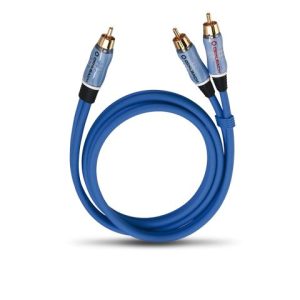
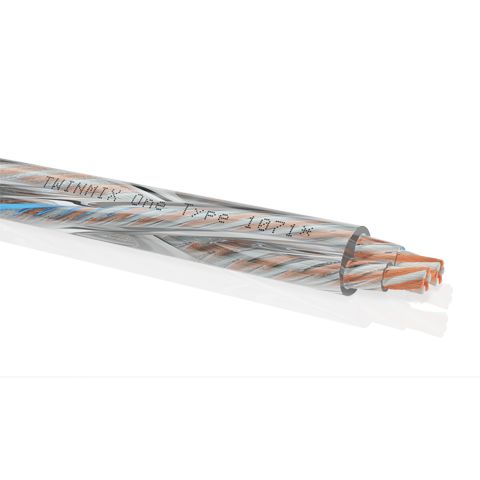
Oehlbach Twin Mix One M is a stereo speaker cable for connecting an amplifier to passive speakers. Its conductive structure combines stranded OFC and SPC elements. Extremely fine wires and a flexible jacket make the cable easier to route behind furniture and along skirting boards. This transparent, round cable has a 2 × 3.0 mm² cross-sectional area and a 9.0 mm outer diameter.
Oehlbach Twin Mix One M is a stereo speaker cable designed to connect an amplifier or power amplifier to passive speakers. It carries the amplified signal directly from the amplifier output to the speaker terminals. Its two conductors form the electrical circuit required for one speaker.
Hybrid conductor construction
The conductive section of the cable consists of three stranded oxygen-free copper elements and three silver-plated oxygen-free copper elements. This is therefore not an OFC-only copper cable: its construction combines OFC and SPC conductors.
Each stranded element is made from extremely fine individual wires. This multi-strand construction helps the cable remain flexible when it is routed behind furniture or along skirting boards. The added flexibility also makes it easier to guide the cable towards terminals installed at different heights.
Outer jacket and cable routing
The outer jacket is made from a transparent plastic compound. It is robust yet highly flexible. The transparent finish leaves the internal cable construction visible, making the cable suitable for installations where part or all of the route remains exposed.
The 9.0 mm outer diameter must be considered when planning space inside cable trunking, furniture openings and wall apertures. Clips, sleeves and grommets should accommodate a cable of this diameter without compressing it. The round geometry also makes it easier to select appropriately sized cable supports and protective sleeves.
Leave a relaxed bend near both the amplifier and the speaker when routing the cable. A sharp bend can make the ends more difficult to prepare and may place unnecessary strain on the terminals. Do not trap the cable beneath furniture legs or pull it taut between its two connection points.
Planning the required length
The stated sales unit is 1.00 m. Before ordering, check how the selected quantity is interpreted and whether the cable is supplied without connectors. Begin by measuring the actual route from the amplifier to each speaker. Follow the intended path along furniture and skirting boards rather than measuring a straight line across the room.
Add a small allowance for preparing the ends and for moving the equipment when necessary. A pair of passive speakers requires two separate cable runs. For a neat installation, it is useful to allow a similar amount of free cable on both sides of the system.
Connecting the conductors
The cable has a conductor cross-sectional area of 2 × 3.0 mm². This means that the outer jacket contains two separate conductors. One connects to the positive terminal and the other to the negative terminal of the relevant speaker channel.
Before preparing the ends, decide which conductor will serve each polarity. Keep this assignment consistent at the amplifier and speaker ends. If the polarity is reversed on one speaker, the central stereo image and bass reproduction may become weaker.
Choose the termination method to match the terminals on your equipment. If the terminals accept bare wire, carefully twist the fine strands together before inserting them. No loose strand should be allowed to touch the terminal of the opposite polarity. Banana plugs or spade connectors must be suitable for both the conductor size and the design of the relevant terminals.
Use in an audio system
In a stereo system, one cable length runs from the left amplifier channel to the left speaker. A second length connects the right channel to the right speaker. The same arrangement applies when a separate power amplifier is used.
The cable can also be used for passive home cinema speaker channels. Each channel requires its own run from the AV amplifier to the corresponding speaker. For a larger system, calculate the total requirement by adding together the lengths of all the individual routes.
This is not a line-level signal cable. It cannot replace an RCA, XLR or digital connection between an audio source and an amplifier. Active speakers equipped with line-level inputs require the appropriate type of signal cable for those connections.
Technical specifications
| Model | Oehlbach Twin Mix One M |
|---|---|
| Product type | Stereo speaker cable |
| Application | Connecting an amplifier or power amplifier to speakers |
| Conductor construction | Three stranded OFC elements and three stranded SPC elements |
| Conductor materials | Oxygen-free copper and silver-plated oxygen-free copper |
| Individual wires | Extremely fine |
| Conductor cross-sectional area | 2 × 3.0 mm² |
| Outer cable diameter | 9.0 mm |
| Geometry | Round |
| Jacket material | Transparent plastic compound |
| Jacket properties | Robust and highly flexible |
| Colour | Transparent |
| Sales unit | 1.00 m |
FAQ
How much cable do I need for a stereo system?
Add together the lengths of the two separate cable runs, include an allowance at both ends, and use the resulting total to select the required number of 1.00 m units.
Can one cable be used to connect both speakers?
No. One two-conductor cable length forms the circuit for a single speaker. The left and right channels require separate cable lengths.
How do I maintain the correct polarity?
Choose which conductor will be positive before preparing the cable ends. At both ends, connect that same conductor to terminals marked with the same colour.
Can this cable be used in a home cinema system?
Yes. It is suitable for connecting a passive speaker to the corresponding channel of an AV amplifier. Plan an independent cable run for every speaker.
Which type of termination should I choose?
The choice depends on the terminals fitted to the amplifier and speaker. Bare wire, a banana plug or a spade connector must be compatible with the terminal design.
Is this cable suitable for active speakers?
It is suitable only when the speaker has speaker-level inputs intended to receive an amplified signal. A conventional line-level input requires a signal cable instead.
How should I plan the cable route through a narrow space?
Allow enough room for at least the 9 mm cable profile, together with additional space for bends. Do not compress the jacket with clips or form sharp corners in the route.
Related products and categories
Related products