Rotel C8 Power Amplifier
2 600,00 €
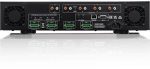
The Rotel C8 is an eight-channel Class A/B power amplifier for custom-installed and multi-zone audio systems. Four analogue inputs can be distributed to all zones through a matrix, allowing sources to be assigned across several listening areas. An oversized toroidal transformer supplies sixteen output devices. IP, RS-232 and 12 V trigger connections simplify integration with a control system.
The Rotel C8 power amplifier is an eight-channel Class A/B model designed for custom-installed audio systems. It can power several stereo zones or individual system channels from a single chassis. Four analogue sources can be distributed throughout all zones, allowing one amplifier to serve multiple listening areas.
Purpose and system planning
This is a custom-installation amplifier, not a conventional integrated stereo amplifier. Sources connect through four analogue line-level inputs. Two channels can be assigned to a stereo system, leaving the remaining channels available for other zones.
In a home cinema system, the C8 can amplify channels for which a processor or AV receiver provides an analogue signal. In a multi-zone installation, the input matrix distributes the available sources to different rooms or listening areas. A digital player can also be connected through its analogue output.
System planning should therefore begin with the required number of channels, the sources available at line level and the way those sources need to be shared between zones. The C8 combines multi-channel amplification and source distribution in one enclosure, making it particularly suitable for centrally installed audio systems.
Power supply and output
An oversized Rotel-manufactured toroidal transformer supplies sixteen output devices. The amplifier uses amplification technology developed by Rotel.
The maximum specified output is 70 W per channel when all eight channels are driven into 4 Ω. Continuous output is rated at 50 W per channel with all channels operating into 8 Ω. These figures should not be treated as directly equivalent because the speaker load and the conditions used to rate the output are different.
In bridged mode, the specified output is 140 W into 4 Ω. This mode is useful when higher output from one connection matters more than retaining the full channel count. Bridging a pair of channels reduces the number of channels that remain available for independent use, so the required zone layout should be established before configuring the amplifier.
Source and control connections
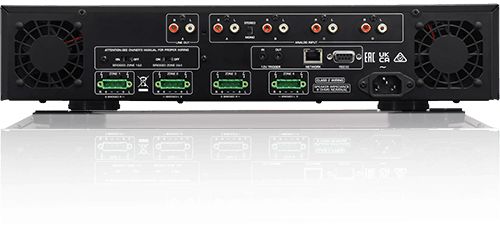
The four analogue inputs are linked to the zone matrix. This allows the same source to be routed to the intended listening zones and reduces the need to install a separate source-switching device in every room.
A control system can be connected through IP or RS-232. IP is intended for network-based automation, while RS-232 supports wired control-system integration. The 12 V trigger connection can synchronise power-on operation with a compatible control device.
These connections make the C8 suitable for installations in which the amplifier is housed away from the listening rooms. Source selection and essential settings can still be incorporated into the wider control system rather than requiring routine access to the equipment rack.
Installation settings
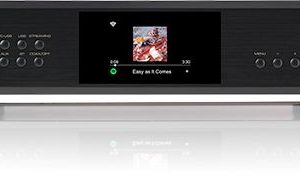
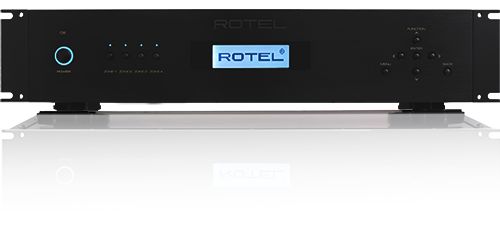
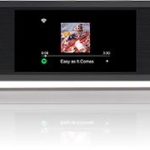
The front panel includes a display and control buttons. They provide source selection and separate adjustment of volume, bass and treble, allowing the main settings to be configured directly at the amplifier.
Bass and treble can each be adjusted over a ±10 dB range. The bass reference point is 100 Hz, while the treble reference point is 10 kHz. It is sensible to begin with both controls in their neutral positions. The sound in each zone can then be adjusted to suit its acoustics and the placement of its speakers.
Small changes are generally the most useful starting point. Listening from the main position in each room helps determine whether correction is needed, while separate zone settings allow differing room conditions to be addressed without applying the same tonal balance everywhere.
Rack installation and enclosure
The 2U chassis does not require additional free rack space above or below it. This helps use the available equipment-cabinet space efficiently. Its 414 mm enclosure depth means that additional room must still be allowed behind the amplifier for plugs and connected cables.
At 16.7 kg, the amplifier requires a rack shelf or mounting system rated for the appropriate load. The front panel is 88.1 mm high, although the overall enclosure height is 97 mm. The model is available only in black.
When planning the rack, both the amplifier depth and the space needed for cable bends should be considered. The supporting hardware must also be suitable for the unit’s weight rather than being selected solely from its 2U rack height.
Technical specifications
| Type | Class A/B custom-installation power amplifier |
|---|---|
| Amplifier channels | 8 |
| Maximum output power | 70 W per channel, all 8 channels driven into 4 Ω |
| Continuous output power | 50 W per channel, all 8 channels driven into 8 Ω |
| Bridged-mode output | 140 W into 4 Ω |
| Amplification technology | Rotel-developed amplification technology |
| Transformer | Oversized Rotel-manufactured toroidal transformer |
| Output devices | 16 |
| Audio inputs | 4 analogue inputs |
| Source distribution | Four-input matrix for all zones |
| Front-panel equipment | Display, source-selection controls and setting controls |
| Adjustments | Independent volume, bass and treble adjustment |
| Control integration | IP and RS-232 |
| Trigger connection | 12 V |
| Intermodulation distortion | Less than 0.1%, measured at 60 Hz and 7 kHz with a 4:1 ratio |
| Total harmonic distortion | Less than 0.1% |
| Damping factor | 80, from 20 Hz to 20 kHz into 8 Ω |
| Tone-control range | ±10 dB at 100 Hz and 10 kHz |
| Channel separation | Greater than 50 dB |
| Line-input sensitivity | 0.3 V |
| Line-input impedance | 31 kΩ |
| RCA line-input overload level | 2.8 V |
| Frequency range | 10 Hz-100 kHz through the line-level inputs |
| Signal-to-noise ratio | 100 dB, IHF A-weighted, through the line-level inputs |
| Dimensions | 430 × 97 × 414 mm; 17 × 3.9 × 16.3 in |
| Rack height | 2U |
| Front-panel height | 88.1 mm; 3.5 in |
| Installation clearance | No additional clearance required above or below |
| Power requirements | 120 V, 60 Hz regional version |
| Power consumption | 570 W |
| Normal standby consumption | Less than 0.5 W |
| Network standby consumption | Less than 2 W |
| Heat output | 1,537 BTU/h at 4 Ω and one-eighth power |
| Weight | 16.7 kg |
| Colour | Black |
FAQ
What type of source can be connected?
Any source with an analogue line-level output is suitable. This could be a preamplifier, network player, digital-to-analogue converter (DAC) with an analogue line-level output, or an output from an AV processor.
How are the four inputs used across multiple zones?
The input matrix allows the connected analogue sources to be routed to the system’s zones. The source can be selected from the front panel or through a connected control system.
When should bridged mode be used?
Choose bridged mode when one output requires more power and you can give up some independently available channels. The connected load must meet the stated condition for this operating mode.
Is the amplifier suitable for stereo and home cinema systems?
Yes, provided that the system supplies an analogue line-level signal. Two channels can be allocated to a stereo pair. In a home cinema installation, the channels can be controlled by a processor or AV receiver.
How should I begin adjusting the tone controls?
Start with the bass and treble controls in their neutral positions. Listen from the main seating position and make changes in small steps. Separate settings can be selected for different zones.
Which automation connection should I choose?
The IP connection is intended for control over a network. RS-232 is suitable for wired control-system integration. The 12 V trigger is used for synchronised power-on operation.
Is this version suitable for the Lithuanian mains supply?
The specified regional version is designed for a 120 V, 60 Hz power supply. It must not be connected directly to Lithuania’s 230 V, 50 Hz mains supply.