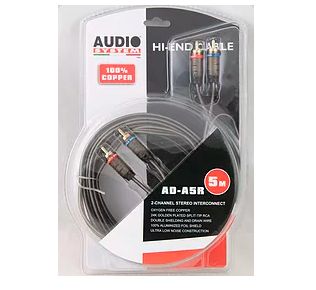
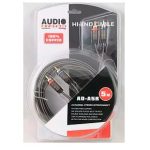
Audio System AD D1 RCA Interconnect Cable
26,00 €
Audio System AD D1 is a 1-metre RCA interconnect cable for connecting car audio components. Its oxygen-free copper conductor is made from 100% copper. Quad shielding helps reduce the effect of interference from surrounding electrical circuits on the analogue signal. The short length suits components installed close together and helps avoid unnecessary excess cable.
Audio System AD D1 is a 1-metre RCA interconnect cable for car audio systems. It carries an analogue line-level signal between devices equipped with RCA connections. Quad shielding helps reduce the effect of interference from nearby electrical circuits.
Purpose and choosing the right length
This cable is suitable for a short connection between car audio components installed close to one another. It can connect the RCA line-level sockets of a source unit, audio processor or amplifier. Both devices must have an RCA output and input intended for the required connection.
A short cable helps avoid leaving unnecessary cable behind trim panels or inside an equipment compartment. Before choosing the length, measure the actual routing path rather than the straight-line distance between the devices. Allow for bends, partitions and enough slack around the connectors.
The cable should reach the sockets without being pulled tight. A small amount of spare length makes it easier to withdraw a component for inspection and reduces mechanical strain on the connections. This product is not designed to carry a speaker-level signal or a vehicle’s 12-volt power supply.
Copper conductor and shielding
The conductor is made from 100% oxygen-free copper (OFC). This means that the stated conductor material is copper throughout, rather than another metal with a copper coating. The OFC designation describes the conductor material; it does not specify the plating used on the RCA connectors.
The purpose of the quad shielding is to limit external electromagnetic interference entering the analogue signal path. This is particularly relevant in a vehicle, where audio cables may run near power wiring and other electrical equipment. Shielding does not replace careful route planning or correct system grounding.
The cable is made in Italy.
Using the RCA connection
In a vehicle, do not connect the RCA cable directly to speaker outputs unless the equipment has a suitable line-level converter.
The number of RCA connections required for a particular route depends on the channels being carried. Their quantity and arrangement must match the sockets on the connected devices. This cable does not split the signal, so separate connections are required for multiple independent signal paths.
Insert each plug straight into its socket and hold the plug by its body. When disconnecting it, do not pull on the cable itself. This reduces strain where the cable enters the plug.
Routing the cable in a vehicle
Route the RCA cable away from amplifier power cables, alternator circuits and electric motors. If signal and power cables must cross, arrange the crossing at as close to a right angle as practical. Long parallel cable runs can increase the likelihood of electrical interference.
Do not trap the cable beneath trim components or bend it through a very tight angle. Secure it so that it cannot move into seat mechanisms or other moving parts. Avoid locations exposed to excessive heat, moisture or sharp sheet-metal edges.
After installation, test the system with the engine switched off and then with the engine running. If the noise changes with engine speed, inspect the cable route, check that the connectors are fully inserted and examine the system grounding. Even multi-layer shielding cannot eliminate hum caused by a poorly arranged grounding circuit.
Use in different systems
In a car stereo system, the cable can connect an RCA line output to the input of a nearby amplifier. It is also suitable for a subwoofer amplifier when the signal is carried through analogue RCA connections. The equipment itself determines the required channel arrangement and number of connections.
In a home stereo or cinema system, a 1 m cable can connect adjacent analogue RCA sockets on a source and amplifier. It is not an HDMI, optical, speaker or digital network cable.
When connecting several amplifiers or other components, plan a separate connection for every independent signal path. The AD-D1 does not act as a splitter and does not change the channel configuration of the connected equipment.
Technical specifications
| Model | Audio System AD D1 / AD-D1 |
|---|---|
| Product type | RCA interconnect cable |
| Length | 1 metre |
| Connector type | RCA |
| Conductor material | Oxygen-free copper (OFC), 100% copper |
| Shielding | Quad shielding |
| Country of manufacture | Italy |
FAQ
When should I choose a cable of this length?
It is intended for components installed near one another. Measure the entire cable route and allow a little slack around the connectors.
Can it connect a car stereo to an amplifier?
Yes, provided that the stereo has an analogue RCA line output and the amplifier has a corresponding input. Before purchasing, make sure that the 1 m length is sufficient for the complete routing path and the necessary connector slack.
Is the cable suitable for a subwoofer amplifier?
It can carry a line-level signal to an RCA input. The cable does not replace a power cable, speaker wire or line-level signal converter.
Can it be used in a home audio system?
Yes. It can connect devices with compatible analogue RCA sockets if the available cable length is sufficient. It does not replace other types of audio or video connection.
Can one cable connect several amplifiers?
No. The cable does not split the signal. Multiple independent routes require separate cables or a suitable configuration of the equipment’s outputs.
How can I reduce the likelihood of hum or other interference?
Route the RCA cable away from power circuits and make sure the plugs are inserted securely. Correct grounding throughout the system is also important.
Does quad shielding solve every noise problem?
No. Shielding reduces the effect of external interference, but it cannot correct improper grounding, damaged connections or poorly routed cables.