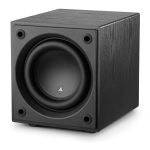
TAD TL-1801 Low-Frequency Driver
2 395,00 €
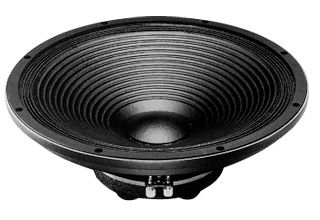
The TAD TL-1801 is an 18-inch low-frequency driver for installation in a separate enclosure. It has a rated impedance of 8 Ω and a recommended enclosure volume of 170-500 litres. Its stiff cellulose-and-aramid cone, long-excursion voice coil and heat-dissipation design are intended for higher input power. Separate amplification and a crossover are required.
The TAD TL-1801 low-frequency driver is an 18-inch (460 mm) unit designed for installation in a separate enclosure. It is not a ready-to-use loudspeaker. Its rated impedance is 8 Ω, and the recommended enclosure volume is 170-500 litres. These are starting points when choosing an amplifier and planning the enclosure.
Construction
The cone combines stiff cellulose and aramid fibre. It is laminated with a polymer film and has a water-repellent surface treatment. Its stiffness helps limit cone deformation under heavier loads, while the surface treatment is part of the cone’s construction; it does not turn the finished speaker into a weatherproof product.
The long-excursion voice coil uses edge-wound oxygen-free copper. Together with the heat-dissipation design, it allows the driver to accept higher input power. A ferrite magnetic circuit is supported by a seven-arm die-cast aluminium-alloy frame. These parts belong to the driver itself; the enclosure, amplification and frequency filtering must be provided as part of the finished system.
Connection and crossover setup
Connect the TL-1801 with speaker cable to a suitable amplifier output. Its terminal accepts cable with a cross-sectional area of up to 14 mm². A line-level subwoofer output cannot drive the unit directly. If your source provides that kind of output, a power amplifier is needed between the source and the driver.
The TL-1801 has no built-in amplifier or controls. Frequencies must be divided by an external crossover or a system audio processor. 800 Hz is the highest recommended crossover frequency, not a setting that every installation should use. Choose the crossover in relation to the other speakers and the enclosure, then assess how the speakers blend at the listening position.
Rated input power is 200 W, while maximum input power is 800 W. The figures describe different ratings. The maximum is specified using the EIAJ method and should not be treated as a continuous-power rating. The stated frequency range is 26-2,000 Hz, but no measurement tolerance is supplied, so the endpoints alone do not describe how even the response is across that range.
Enclosure and installation planning
The recommended enclosure volume is a range rather than a single prescribed size. It gives the enclosure designer room to work toward the desired low-frequency behaviour, but volume alone cannot predict the final result. The free-air resonance, Q values, moving mass and equivalent acoustic volume listed below provide further information for that design work. Consider them together with the enclosure you intend to build.
The front baffle needs a 426 mm opening. Check the 441 mm mounting dimension and the pattern of eight mounting holes before cutting or reusing a baffle. Leave room on its front face for the full 464 mm outside diameter. Behind the baffle, allow for the driver’s 176 mm depth and provide support for its 12.6 kg weight. Checking all of these dimensions matters when deciding whether the unit will fit an existing cabinet.
If the enclosure will stand near a wall or in a corner, consider that position while planning the system. Room boundaries affect the low-frequency balance heard at the listening position. Once the enclosure is in place, use that position to judge the final placement and crossover setting.
Use in an audio system
The TL-1801 can form the low-frequency section of a planned stereo or home cinema system. Either use calls for a separate enclosure, amplification and frequency filtering. If you use more than one driver, the way you connect them determines the load presented to the amplifier. The rated impedance stated here applies to one driver, so check the combined load against the amplifier you plan to use.
The separately sold DP-1801 replacement diaphragm is a repair part. It is not an additional accessory required to operate a working TL-1801.
Technical specifications
| Type | Separate low-frequency driver for enclosure mounting |
|---|---|
| Nominal size | 18 inches (460 mm) |
| Rated impedance | 8 Ω |
| Frequency range | 26-2,000 Hz; measurement tolerance not specified |
| Highest recommended crossover frequency | 800 Hz |
| Rated input power | 200 W |
| Maximum input power | 800 W, EIAJ method |
| Sound pressure level | 96.5 dB at 1 W and 1 m |
| Voice coil | Edge-wound oxygen-free copper; 100 mm diameter, 23 mm winding height; long-excursion design |
| Magnetic circuit | Ferrite; 1.12 T magnetic flux density; 2.82 × 10⁻³ Wb total magnetic flux |
| Cone | Cellulose and aramid fibre; polymer-film laminate; water-repellent surface treatment |
| Frame | Seven-arm die-cast aluminium alloy |
| Heat management | Heat-dissipation design |
| Connection | Speaker-cable terminal; accepts cable up to 14 mm² (6 AWG) in cross-sectional area |
| Recommended enclosure volume | 170-500 l |
| Baffle opening diameter | 426 mm |
| Mounting dimension | 441 mm; eight mounting holes |
| Dimensions | 464 mm diameter × 176 mm depth |
| Weight | 12.6 kg |
| Free-air resonance frequency, Fs | 26 Hz |
| Mechanical Q, Qms | 7.9 |
| Electrical Q, Qes | 0.39 |
| Total Q, Qts | 0.37 |
| Force factor, BL | 21 Tm |
| Moving mass including air load, Mms | 158 g |
| Moving diaphragm mass, Mmd | 114 g |
| Suspension compliance, Cms | 2.37 × 10⁻⁴ m/N |
| Equivalent acoustic volume, Vas | 0.500 m³ (500 l) |
| Effective diaphragm area, Sd | 0.122 m² |
| Maximum linear excursion in one direction, Xmax | 7.5 mm |
| Excursion before damage | 40 mm peak to peak |
| Volume displacement, Vd | 914 cm³ |
| Voice-coil DC resistance, Revc | 6.6 Ω |
| Voice-coil inductance, Levc | 2.0 mH at 1 kHz |
| Reference efficiency, η₀ | 2.20% |
FAQ
Is this a ready-to-use subwoofer?
No. It is a separate driver that needs an enclosure, an amplifier and a crossover. The enclosure design is the first major decision when building a system around it.
Can I connect it directly to an AV receiver’s subwoofer output?
No. A line-level output does not power a speaker driver directly. A power amplifier is needed between that output and the TL-1801.
Does the recommended volume specify one exact enclosure size?
No. The stated range accommodates different enclosure designs. Choose the final volume as part of the enclosure design and the low-frequency performance you want to achieve.
How should I choose the crossover frequency?
Set it in relation to the other speakers in the system and the enclosure. The published upper recommended limit is not a setting that must be used in every system. Listen to the transition at the intended listening position when making the final adjustment.
How can I check whether the TL-1801 fits my enclosure?
Check for a 426 mm front-baffle opening, the 441 mm mounting dimension and the eight-hole layout. Also make sure the front face has room for the 464 mm outside diameter, with adequate space and support behind the baffle.
What should I consider when installing several drivers?
Calculate the combined load from the connection arrangement and check it against the amplifier’s capabilities. Plan the enclosure volume and mounting for each driver as well.