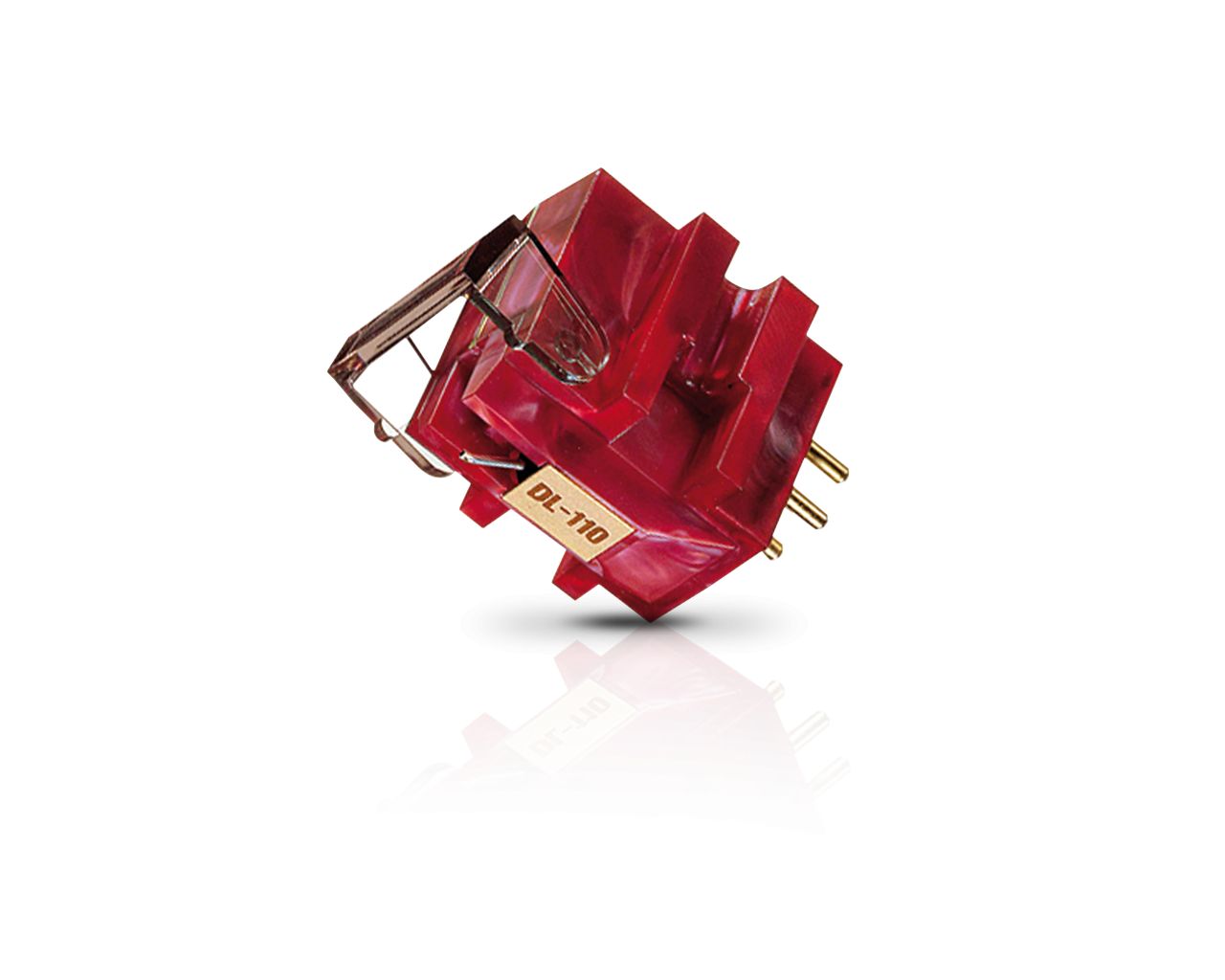
Denon DL-110 Phono Cartridge
330,00 €
The Denon DL-110 is a high-output MC phono cartridge for vinyl playback systems with an MM phono input. Its 1.6 mV output allows it to be used without a separate low-output MC phono stage. The special elliptical diamond stylus has a recommended tracking force of 1.8 ± 0.3 g, making accurate tonearm setup important for correct stylus operation.
The Denon DL-110 phono cartridge is a high-output MC model designed for vinyl record playback. It combines the moving-coil operating principle with the ability to use a conventional MM phono input. This is the most important selection criterion for buyers who want an MC cartridge without a separate low-output MC phono stage.
Its 1.6 mV output voltage is designed for an MM-type phono circuit. The recommended 47 kΩ terminating resistance corresponds to the setting commonly used by MM inputs. The cartridge weighs 4.8 g, so the tonearm must be balanced again when replacing a previous cartridge.
High-output MC design
This model is a moving-coil phono cartridge. Its high-output construction provides an output voltage of 1.6 mV while retaining the moving-coil operating principle.
The model was released in 1983. Its suitability today is determined not by its release date, but by the correct phono input and accurate mechanical adjustment. The cartridge’s electrical impedance of 160 Ω is not the load setting to select on the amplifier. A separate 47 kΩ terminating resistance is recommended for the input.
Connecting it to an audio system
The cartridge should be connected through the turntable’s tonearm to an MM phono stage input. This phono stage may be a separate component or built into a stereo amplifier. An AV receiver is also suitable if it includes an MM phono input.
The cartridge must not be connected directly to an AUX, CD, or other line-level input. Such a connection would lack the gain and frequency equalisation required for a phono signal. If the amplifier does not have a phono input, an external MM phono stage is required between the turntable and the line-level connection.
MM is the intended default choice, rather than a low-output MC setting. Selecting the correct mode helps prevent unsuitable gain or loading. The cartridge must be connected to an input, not to an amplifier output.
Stylus profile and channel reproduction
The DL-110 uses a 0.1 × 0.2 mm solid special elliptical diamond stylus. Its stylus is made from solid diamond and has an elliptical profile. It is not a Shibata stylus.
Confirmed channel separation is at least 25 dB. This measurement describes how effectively the left and right channels remain separated during stereo record playback. The final result also depends on accurate cartridge alignment in the tonearm.
Setting the tracking force
The recommended tracking force is 1.8 ± 0.3 g. This gives a recommended adjustment range of 1.5-2.1 g, with 1.8 g serving as the initial setting.
Begin by balancing the tonearm according to the turntable’s design. Set the tracking force after balancing, then verify it with a stylus force gauge. The scale on the tonearm alone may be less accurate than a separate measuring device.
Do not retain the previous counterweight setting after replacing a cartridge of a different weight. The tonearm must be balanced again to account for this model’s 4.8 g weight. Once balancing is complete, check the cartridge alignment with a template suitable for the turntable.
Who this model is suitable for
This model is suitable for a stereo amplifier or AV receiver equipped with an appropriate MM input. A separate MC input is not required.
The 20 Hz-45 kHz playback frequency range describes the signal reproduced by the cartridge. It does not override the frequency limits of the loudspeakers, amplifier, or record itself. This specification should therefore be considered as one part of the complete playback chain.
When choosing and installing the DL-110, it is important to distinguish electrical compatibility from mechanical setup. The electrical side requires an MM input with a 47 kΩ load. The mechanical side requires correct installation, tonearm balancing, accurate alignment, and precise tracking-force adjustment.
Technical specifications
| Model | Denon DL-110 |
|---|---|
| Product type | High-output MC phono cartridge |
| Operating principle | Moving coil |
| Recommended phono input | MM phono input |
| Output voltage | 1.6 mV |
| Frequency range | 20 Hz-45 kHz |
| Electrical impedance | 160 Ω |
| Recommended terminating resistance | 47 kΩ |
| Channel separation | At least 25 dB |
| Recommended tracking force | 1.8 ± 0.3 g |
| Stylus | Solid special elliptical diamond stylus |
| Stylus dimensions | 0.1 × 0.2 mm |
| Cartridge weight | 4.8 g |
| Release year | 1983 |
FAQ
Why can an MC cartridge be connected to an MM input?
The DL-110 has a high-output MC design with an output voltage of 1.6 mV. This allows it to be used with a conventional MM phono input.
Is a separate phono stage required?
No separate phono stage is required if the amplifier has a suitable MM phono input. If it does not have such an input, an external MM phono stage will be needed.
Can it be connected to an AUX or CD input?
Not directly. A line-level input does not provide the gain or frequency equalisation required for a phono signal. An MM phono stage must be placed between the turntable and the line-level input.
Which tracking force should I set first?
Start at 1.8 g and verify the setting with a stylus force gauge. The final adjustment must remain within the recommended range of 1.5-2.1 g.
Which load should I select on the phono stage?
The recommended terminating resistance is 47 kΩ. The 160 Ω figure describes the cartridge’s electrical impedance, not the input load that should be selected.
Is the cartridge suitable for an AV receiver?
Yes, provided that the AV receiver has an MM phono input. If it offers only line-level inputs, an external MM phono stage will be required.
Does the DL-110 use a Shibata stylus?
No. The confirmed stylus profile is special elliptical, not Shibata.
What must be adjusted after replacing the previous cartridge?
Balance the tonearm again, set the tracking force, and check the cartridge alignment. The previous settings may not be suitable for a cartridge weighing 4.8 g.