SUMIKO S.0 Subwoofer
449,00 €
The SUMIKO S.0 is an active subwoofer for stereo and home cinema systems. Its sealed enclosure contains a downward-firing 165 mm long-throw driver. The integrated 120 W RMS Class AB amplifier removes the need for a separate power amplifier. Speakon, low-level, and LFE inputs allow the connection method to be matched to the system’s available output. The 0° or 180° phase setting helps integrate the bass with the main speakers.
The SUMIKO S.0 subwoofer is a compact active model designed for stereo and home cinema systems. Its sealed enclosure houses a downward-firing 165 mm long-throw driver. An integrated 120 W RMS amplifier allows the subwoofer to be used with audio equipment that provides a suitable signal output.
Three signal inputs provide flexibility for different system configurations. The available options are a high-level Neutrik Speakon input, a low-level input using a single phono connection, and an LFE input. A phase switch helps integrate the subwoofer’s bass output with the main speakers.
Compact sealed enclosure
A sealed enclosure has no bass-reflex port. Its operation therefore does not depend on the direction of a port or the clearance required around one. Room boundaries still matter, however, because walls and corners can reinforce particular low frequencies.
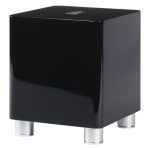
The downward-firing driver directs its energy towards the floor. It needs unobstructed space beneath the enclosure, so the underside of the subwoofer must not be covered. When placing it on a very soft carpet, use a rigid, stable base that preserves the required clearance.
The steel chassis of the 165 mm long-throw driver provides its mechanical foundation. A compact 245 × 275 mm footprint makes it easier to find a suitable position near the audio system. The 280 mm depth should also be considered when allowing space between the subwoofer, the wall, and the connected cables.
Three connection methods
The high-level Neutrik Speakon input accepts a signal from the amplifier’s speaker circuit. This is particularly useful when the system does not provide a dedicated subwoofer output. The correct connection method must be selected according to the output type and circuit arrangement of the specific amplifier.
The low-level input uses a single phono connection and accepts a line-level signal. It can be selected when an amplifier or preamplifier has a suitable low-level output. This method carries the subwoofer signal separately from the cables used for the main speakers.
The LFE input is intended for a dedicated low-frequency effects signal. It is a practical choice with an AV receiver or processor equipped with an LFE output. In this arrangement, frequency distribution is normally managed by the connected home cinema component.
Each method requires a cable appropriate to its connector. Choose one signal path at a time according to the output available from the amplifier, preamplifier, AV receiver, or processor in use.
Integrated amplifier and phase adjustment
The subwoofer contains a Class AB amplifier, so no separate power amplifier is required for its driver. The 120 W RMS figure describes the power rating of the integrated amplifier. It should not be confused with an unspecified peak-power rating.
The phase switch offers 0° and 180° positions. Begin at 0° and listen to a familiar recording from your normal listening position. Then select 180° and compare how consistently the bass integrates with the rest of the system.
The more suitable setting will generally provide a smoother transition between the main speakers and the subwoofer. Do not judge the result by loudness alone. Listen for any reduction in bass around the point where the operating ranges of the main speakers and subwoofer meet.
Frequency limit and system setup
The lower frequency limit is specified as 45 Hz at -3 dB. This measurement qualification is important because it does not indicate equal output at every frequency. Instead, it identifies the point at which the level has fallen by three decibels.
If the amplifier or AV receiver provides an adjustable crossover frequency, use the capabilities of the main speakers as the starting point. Smaller speakers will generally require a higher transition setting, while larger speakers may be suitable for a lower setting.
Always assess the final result from the listening position. Setting the crossover too high can make the physical position of the subwoofer more apparent. Setting it too low can leave a gap between the ranges covered by the main speakers and the subwoofer.
Positioning in the room
For the first trial, place the subwoofer near the front section of the system but not directly in a room corner. Corner placement can strongly emphasise individual bass frequencies. If the bass sounds excessive, gradually increase the distance between the subwoofer and the corner.
The sealed enclosure means that no clearance is needed for a rear bass-reflex port. Walls can still affect the audible balance, however. Move the subwoofer in small steps and listen from the same position after every adjustment so that the differences can be assessed consistently.
A level, firm supporting surface is important for the downward-firing driver. Do not obstruct the space beneath the enclosure or press it into a soft surface. This preserves the operating space intended for the driver.
Use in stereo and home cinema systems
Select the input according to the available output on the particular system and the purpose of that output. The supported connection methods and their appropriate uses are explained above.
Using two units can be considered only with a system that provides suitable signal distribution. The AV receiver or processor must be capable of managing both outputs. Each subwoofer would then need to be positioned and adjusted separately from the listening position.
Finish
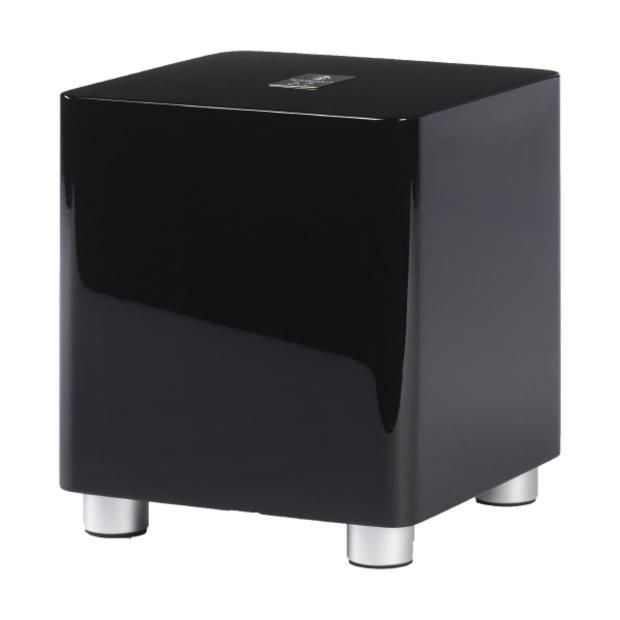
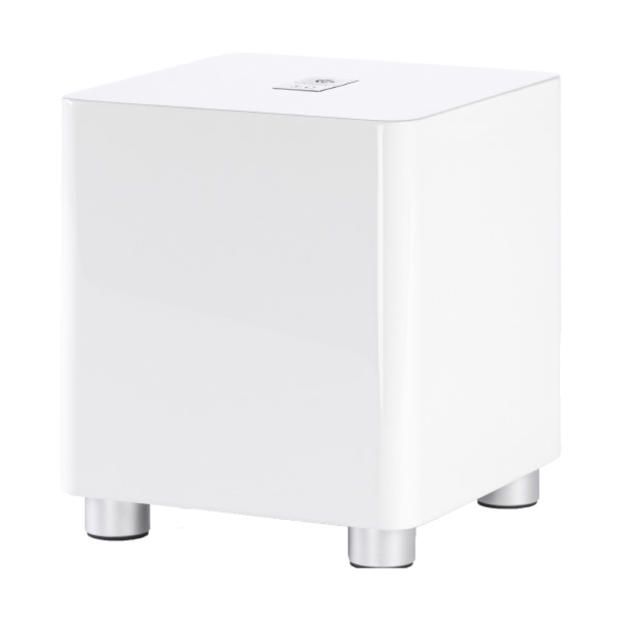
The original store description lists a gloss black Piano Black finish or a white lacquer finish. A gloss surface complements contemporary audio equipment, but it also reflects light in the surrounding room clearly. These reflections are worth considering when selecting the final position.
Technical specifications
| Model | SUMIKO S.0 |
|---|---|
| Type | Active subwoofer |
| Enclosure type | Sealed |
| Driver orientation | Downward-firing |
| Driver | 165 mm, long-throw |
| Driver chassis | Steel |
| Lower frequency limit | 45 Hz at -3 dB |
| High-level input | Neutrik Speakon |
| Low-level input | Single phono connection |
| LFE input | Phono connection |
| Amplifier power | 120 W RMS |
| Amplifier class | AB |
| Phase switch | 0° or 180° |
| Finish | The original store description lists gloss black Piano Black or white lacquer |
| Dimensions | 245 × 275 × 280 mm |
FAQ
Which input should I use with a stereo amplifier?
Check which type of signal output the specific amplifier provides, then select the corresponding input on the subwoofer. Any high-level connection must be made according to the amplifier’s output type and circuit arrangement.
How do I connect the subwoofer to an AV receiver?
First check whether the AV receiver has an LFE output. If it does, select the corresponding input on the subwoofer and manage the frequency distribution and channel level through the receiver.
Which phase setting should I choose?
Compare both settings from your normal listening position. Keep the setting that produces the more consistent transition and the least reduction in bass through the crossover region.
Does the subwoofer need a separate power amplifier?
No. This is an active subwoofer with an integrated Class AB amplifier. It receives the audio signal at the selected signal level.
Can it be placed on a carpet?
The downward-firing driver needs unobstructed space. On a soft or thick carpet, use a stable base that does not cover the underside of the enclosure.
How should I choose a position in the room?
Begin near the front speakers and avoid placing the subwoofer directly in a corner. If the bass is too prominent, move it gradually farther away from the walls.
Can two of these subwoofers be used in one system?
That depends on the signal outputs provided by the amplifier or processor and how those outputs can be managed. Both units would need to be positioned and adjusted separately from the listening position.