TAD E2 Floorstanding Loudspeaker
17 000,00 €
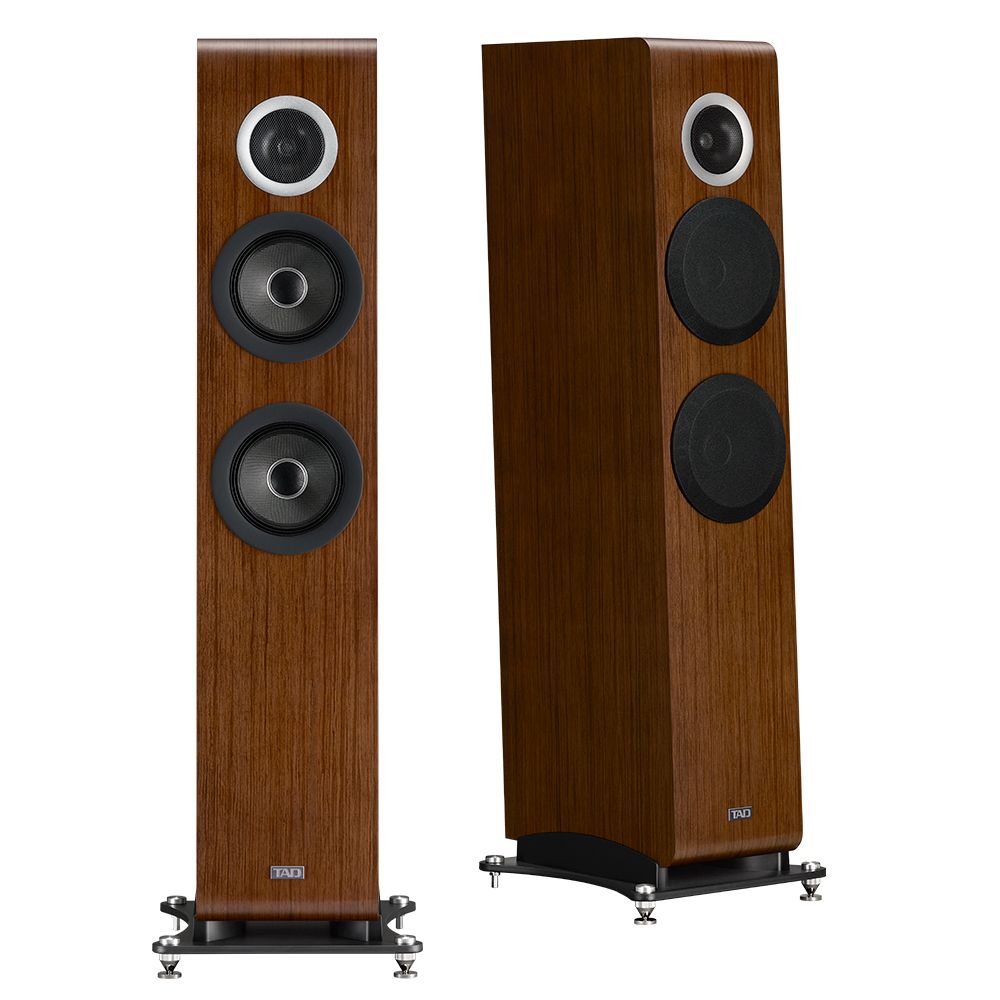
The TAD E2 floorstanding loudspeaker is designed for a high-end stereo system and can also be used as a front home-cinema channel. Its 2.5-way configuration employs two 15.5 cm MACC drivers for different midrange and bass duties. A beryllium dome in a cast-aluminum waveguide controls high-frequency dispersion. The bottom-mounted Bi-Directional Aero-Dynamic Port requires an unobstructed airflow path.
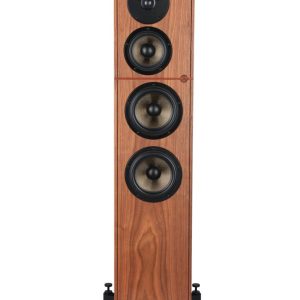
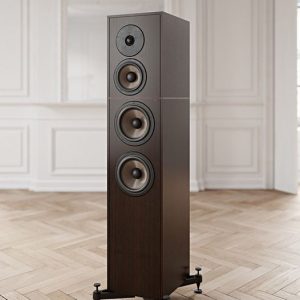
The TAD E2 floorstanding loudspeaker is a 2.5-way vented-box system designed for high-end stereo listening. The TAD-E2-WN version features a walnut-veneer cabinet. Its two 15.5 cm cone drivers perform different functions, while a 2.5 cm beryllium-dome tweeter reproduces the high frequencies.
Who This Loudspeaker Is For
Buyers should consider the 87 dB sensitivity, 4.5 Ω minimum impedance and 405 mm cabinet depth. Additional room is required for cables and airflow through the bottom-mounted port. A stereo system requires two matching loudspeakers. In a multichannel system, they can serve as the front left and right channels.
Choose an amplifier with the loudspeaker’s sensitivity and minimum impedance in mind. The published 150 W figure is the maximum input power. It is not a continuous, RMS or recommended amplifier-power rating.
Beryllium Dome and Controlled Dispersion
The profile of the 2.5 cm beryllium dome is optimized using HSDOM computer analysis. It is mounted in a rigid cast-aluminum waveguide that controls high-frequency directivity and suppresses unwanted resonance.
Controlled dispersion helps maintain more even high-frequency coverage across the listening area. Position the two loudspeakers symmetrically and begin with the same toe-in angle for both. You can then fine-tune the angle while listening from the main seating position.
Two Cone Drivers with Different Roles
Both 15.5 cm drivers use Multi-layered Aramid Composite Cone (MACC) diaphragms. One handles the midrange and bass, while the other is dedicated to bass. They are therefore not two bass drivers operating identically.
Delta-shaped braces reinforce the cones. Flexible dust caps suppress vibration, and damping material is applied to the back of the corrugated surrounds. These measures reduce unwanted vibration through the midrange and bass regions.
A long voice coil operates within a short magnetic gap. The extended pole core helps create symmetrical magnetic flux, while dual shorting rings reduce inductance fluctuations and dynamic distortion.
Cabinet and Bass-Reflex Port
A Bi-Directional Aero-Dynamic Port is installed at the bottom of the cabinet, with openings directed forward and backward.
The port requires an unobstructed airflow path beneath the cabinet and at both its front and rear. Do not block the lower section with carpet or another soft surface. Do not place the loudspeaker tightly against a wall without leaving room for the rear-facing opening.
The narrow, angled front baffle reduces sound-wave diffraction. The cone drivers are positioned to suppress internal standing waves. The SILENT laminated cabinet construction is complemented by sound-absorbing material suspended from the internal braces.
Crossover Network
The specified crossover frequencies are 90 Hz and 2.8 kHz. In this 2.5-way design, the upper 15.5 cm cone driver reproduces midrange and bass frequencies, while the lower driver is assigned to bass.
Connecting an Amplifier
The rear terminals support bi-wiring. Use this arrangement when separate loudspeaker cables are run to the high-frequency and low-frequency crossover sections. The terminals are not two independent audio inputs.
When using a single cable pair, the two terminal sections must remain electrically linked. For bi-wiring, separate the connections as directed in the operating instructions. Switch off the system before connecting the amplifier or loudspeaker cables.
The amplifier must remain stable into the specified load, particularly at higher listening levels. Amplifier suitability depends on more than its headline wattage.
Positioning in the Room
Each cabinet weighs 32 kg, so a stereo pair weighs 64 kg without packaging. Plan the final position before fitting the spikes. Remember to allow space behind and below the cabinet for cables and airflow.
The three main spikes attach to a solid steel base. A separate anti-tip spike improves placement stability. Initially, place both loudspeakers at equal distances from the listening position and maintain matching distances from the side walls. Adjust the distance from surrounding walls to refine bass balance, and use toe-in to tune high-frequency coverage.
Technical Specifications
| Model | TAD-E2, Evolution Two |
|---|---|
| Version | TAD-E2-WN |
| Type | 2.5-way vented-box floorstanding loudspeaker |
| Finish | Walnut veneer |
| Tweeter | 1 × 2.5 cm beryllium dome |
| Waveguide | Cast aluminum; controls directivity and suppresses resonance |
| Cone drivers | 2 × 15.5 cm; one midrange/mid-bass driver and one bass driver |
| Cone construction | MACC aramid composite, delta-shaped braces and flexible vibration-damping dust caps |
| Surrounds | Corrugated; damping material applied to the rear surface |
| Magnetic system | Long voice coil, short magnetic gap, extended pole core and dual shorting rings |
| Frequency response | 30 Hz-60 kHz |
| Crossover frequencies | 90 Hz and 2.8 kHz |
| Maximum input power | 150 W |
| Sensitivity | 87 dB at 2.83 V and 1 m |
| Nominal impedance | 6 Ω |
| Minimum impedance | 4.5 Ω |
| Connections | Rear terminals supporting bi-wiring |
| Bass-reflex port | Bottom-mounted, with forward- and rear-facing openings |
| Cabinet | SILENT laminated construction, narrow angled front baffle and brace-suspended absorbent material |
| Base | 10 mm-thick solid steel plate |
| Dimensions | 320 × 1,085 × 405 mm; height with spikes: 1,113 mm |
| Weight | 32 kg per loudspeaker |
Package Contents
Bass-driver grille × 2, short cable × 2 and spike × 3. Also included are auxiliary foot × 2, spike holder × 3 and non-slip pad × 4. The package list is completed by anti-tip spike × 2 and the operating instructions.
The sales unit is not specified. Before ordering, confirm whether the listed price and package contents apply to one loudspeaker or a pair. This cannot be determined from the accessory quantities alone.
FAQ
What kind of amplifier should I choose?
Stability into the loudspeaker’s lower impedance is more important than a high power figure alone. Do not interpret the maximum-input specification as a recommended amplifier-power range.
Is bi-wiring required?
No. A conventional single-cable connection can be used as long as the two terminal sections remain electrically linked. Choose bi-wiring only when running separate cables to the two crossover sections.
Can these loudspeakers be connected to an AV amplifier?
Yes. They can operate as the front left and right channels. The AV amplifier must be able to drive the specified load stably. Match the other channel loudspeakers according to the system’s tonal balance and layout.
Where should I leave clearance for the bass-reflex port?
Do not obstruct the space beneath the steel base. Leave a clear airflow path at the front and rear of the cabinet. Determine the final distance from the wall according to bass balance in your room.
Do the spikes change the overall height?
Yes. Installing the spikes increases the cabinet height by 28 mm. Account for this when considering the overall height, listening position and placement beside furniture.
Does the stated frequency range eliminate the need for a subwoofer?
The lower frequency limit does not define the bass level achievable in a particular room. In a stereo system, assess loudspeaker placement first. In a home-cinema system, a separate subwoofer may be used for the effects channel.
What does the WN model designation mean?
WN identifies the walnut-veneer version. This finish is associated with the specific TAD-E2-WN model code and does not alter the published electrical specifications.
![Patricia Barber Café Blue [Un-Mastered] jazz album](https://audiocentras.lt/wp-content/uploads/2026/09/patricia-barber-cafe-blue-un-mastered-1-300x300.jpg)