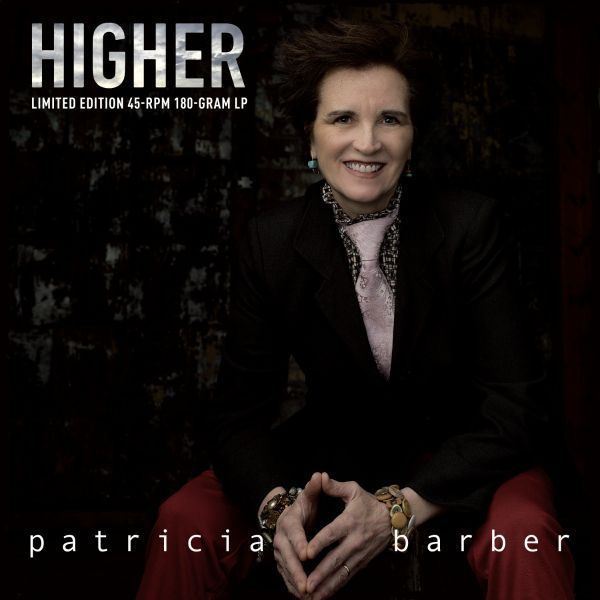
Patricia Barber – Higher Vinyl Edition
75,00 €
Patricia Barber – Higher is a 12-track vinyl edition for listeners interested in Barber’s work and for album collectors. Its four-side programme opens with the eight-part Angels, Birds, and I cycle and also includes three Great American Songbook arrangements. Patrick Mulcahy, John Deitemeyer, and Neal Alger perform on the album, while Katherine Webiansky appears on the final version of The Opera Song.
Patricia Barber – Higher is a 12-track vinyl edition presented across four record sides. It is Barber’s eleventh studio album and opens with the eight-part song cycle Angels, Birds, and I. This release is intended for listeners who appreciate Barber’s original compositions, ensemble performances, and interpretations of the Great American Songbook.
Album Programme
Barber composed the song cycle Angels, Birds, and I for classical singers, jazz performers, and instrumentalists. Its eight pieces complete a stage in the development of the harmonic system she created. As a result, the beginning of the album unfolds as a coherent original programme rather than a collection of unrelated songs. The sequence gives listeners an extended view of Barber’s compositional approach and allows the individual pieces to be heard as parts of a larger musical idea.
The programme is complemented by three arrangements of Great American Songbook material that Barber performs in concert. Their inclusion brings her original compositional direction and her treatment of established repertoire together on one album. This is an important distinction for buyers choosing between a release devoted exclusively to original works and one offering a more varied programme. Here, the familiar repertoire broadens the listening experience without displacing the substantial opening cycle.
Performing Line-up
Patricia Barber is joined by musicians with whom she has collaborated for many years. Patrick Mulcahy plays bass, John Deitemeyer plays drums, and Neal Alger plays guitar. This line-up supports Barber’s material with three central ensemble parts, giving the programme a consistent group setting across its contrasting original compositions and arrangements.
The final track presents a different version of The Opera Song, featuring Katherine Webiansky. It is not merely a repeated title in the programme. The track list clearly distinguishes this performance from the version found on side B, allowing listeners to identify the guest appearance and the album’s closing interpretation.
Recording and Mastering
The album was recorded in Studio Five at Chicago Recording Company. Jim Anderson served as the recording engineer, working on the recording with Ulrike Schwarz. These details clarify the origin of the recording and identify the creative and technical team responsible for preparing the performances at the studio stage.
Mastering was completed by Bob Ludwig at Gateway Mastering. Recording and mastering therefore took place at different studios. For collectors and listeners interested in the work of particular audio professionals, this forms a meaningful part of the release’s production history and makes the separate recording and mastering responsibilities clear.
Four Sides of Music
All 12 tracks are divided among sides A, B, C, and D, with three selections on each side. When played in order, sides A and B develop the album’s opening programme. The title track, Higher, appears on side C, while side D completes the full sequence and closes with the alternate performance of The Opera Song.
The four-side format means that the album is heard in stages and requires the listener to change record sides during playback. To preserve the intended running order, follow the side lettering from A through D. The tracks are also numbered continuously from one to twelve, making it straightforward to locate the next part of the programme after each side ends.
Track List
| Record side | Tracks |
|---|---|
| Side A | 1. Muse 2. Surrender 3. Pallid Angel |
| Side B | 4. The Opera Song 5. High Summer Season 6. The Albatross Song |
| Side C | 7. Voyager 8. Higher 9. Early Autumn |
| Side D | 10. In Your Own Sweet Way 11. Secret Love 12. The Opera Song featuring Katherine Webiansky |
Technical Specifications
| Artist | Patricia Barber |
|---|---|
| Album | Higher |
| Edition type | Vinyl edition |
| Album type | Studio album |
| Place in discography | Eleventh studio album |
| Number of tracks | 12 |
| Programme layout | Four record sides, with three tracks on each side |
| Song cycle | Angels, Birds, and I, eight pieces |
| Ensemble | Patrick Mulcahy – bass; John Deitemeyer – drums; Neal Alger – guitar |
| Guest performer | Katherine Webiansky on The Opera Song |
| Recording location | Chicago Recording Company, Studio Five |
| Recording engineer | Jim Anderson |
| Recording team | Jim Anderson and Ulrike Schwarz |
| Mastering | Bob Ludwig, Gateway Mastering |
FAQ
Who is this edition intended for?
It is intended for listeners interested in Patricia Barber’s work and for vinyl album collectors. Its programme combines an original song cycle with three arrangements drawn from the Great American Songbook, offering both Barber’s own writing and her approach to established material.
Is this a live album?
No. It is a studio album recorded in Studio Five at Chicago Recording Company. The programme does, however, include three arrangements of well-known songs that Barber performs in concert. Their presence does not make this a concert recording.
How should I play the album’s four sides?
Follow the sequence marked A, B, C, and D. Each side contains three numbered tracks, so the continuation of the programme is clearly indicated when it is time to turn over a record or move to the next side.
Are the two tracks titled “The Opera Song” identical?
Side B includes The Opera Song. Side D contains a separately identified version featuring Katherine Webiansky. The track listing distinguishes the guest performance from the earlier version rather than presenting it as an unmarked repetition.
Why is the “Angels, Birds, and I” cycle important?
Barber wrote this eight-part cycle for classical singers, jazz performers, and instrumentalists. It marks the conclusion of a stage in the development of her harmonic system and gives the beginning of the album a continuous compositional structure.
What equipment is required to play this edition?
You will need a turntable and an audio system capable of receiving its signal. If the turntable does not include a phono stage, a separate one may be required between the turntable and the rest of the audio system.
Can this edition be played through stereo and home cinema systems?
It can be played through a system to which a turntable has been connected correctly. The type of system is less important than ensuring that the turntable’s phono signal is handled appropriately.
Who worked on the recording?
Jim Anderson served as the recording engineer, with Ulrike Schwarz also working on the recording. Bob Ludwig completed the mastering at Gateway Mastering, separating the mastering stage from the original studio recording work.