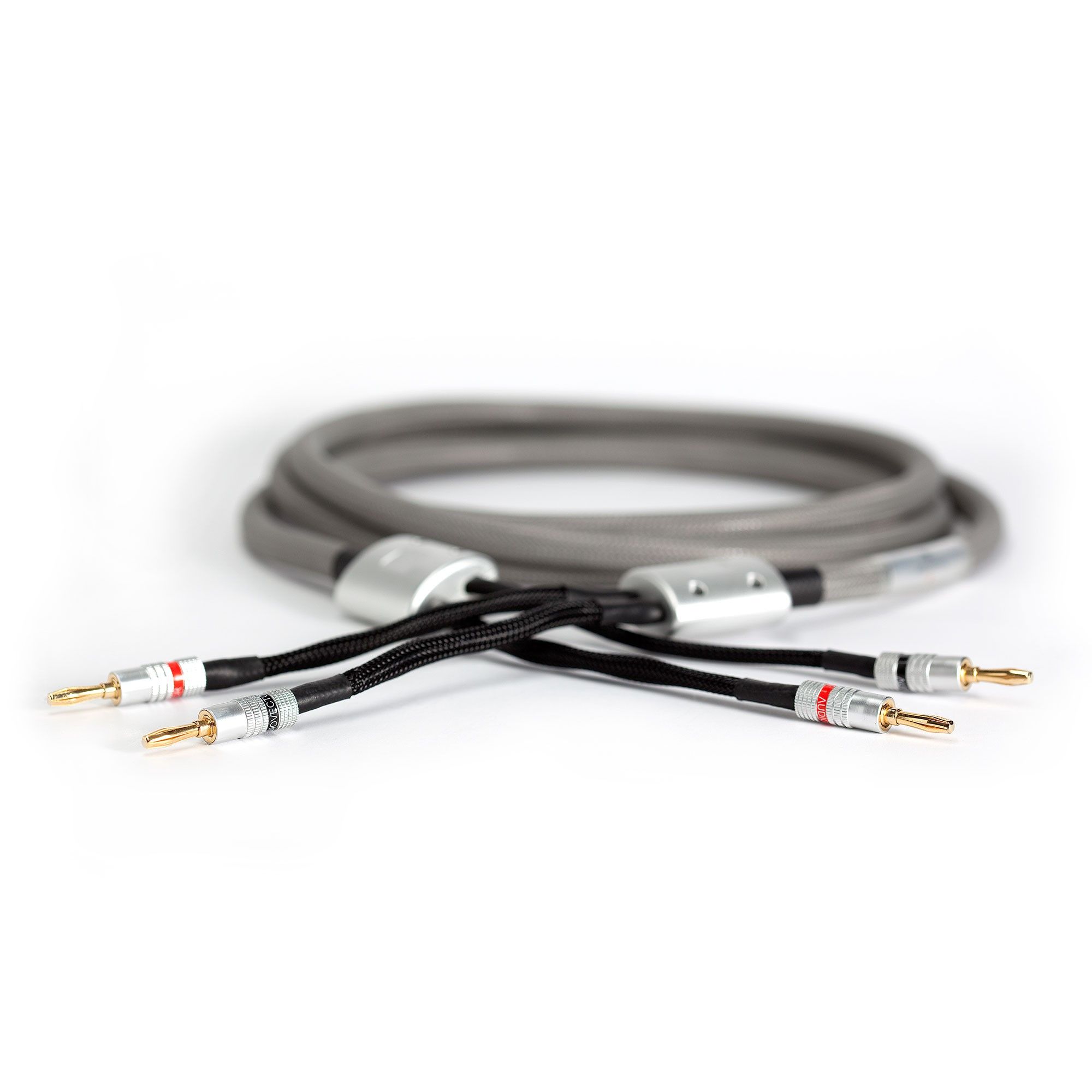
Audiovector ZERO Signature (3.15 m) Speaker Cable
1 400,00 €
Audiovector ZERO Signature (3.15 m) is a speaker cable designed to connect an amplifier to a passive loudspeaker. Its pure copper conductors carry the amplified signal. In the asymmetrical construction, the positive and negative conductors have different cross-sectional areas. The cable is shielded, and its connections to the plugs are crimped rather than soldered. The 3.15 m length makes it possible to plan a specific cable route in advance.
Audiovector ZERO Signature (3.15 m) is a speaker cable designed to connect an amplifier to a passive loudspeaker. It uses pure copper conductors, shielding and an asymmetrical construction. These features are important when planning the connections for a specific loudspeaker system.
Purpose and choosing the right length
The cable carries the amplified signal from an amplifier’s speaker output to the terminals of a passive loudspeaker. It is not intended for line-level RCA or XLR connections, or for carrying a subwoofer signal. Those connections require different types of cable.
The 3.15 m length is suitable when the actual cable route does not exceed the available length. Measure the planned route rather than taking only a straight-line measurement between the components. Allow for the rise to the terminals and leave a small amount of slack at both ends.
The cable should not hang under tension between the amplifier and the loudspeaker. A little extra slack makes it easier to move the equipment and reduces mechanical strain on the connections. However, any surplus length should not be tightly coiled near power supplies.
Conductor construction
The signal conductors are made from pure copper. They consist of a predetermined number of individual strands.
The positive and negative conductors have different cross-sectional areas. This forms part of the cable’s asymmetrical construction. The difference between the conductors does not change the connection rule: the same polarity must be maintained at both ends of the system.
The seller’s description also uses the name ZERO Compression Signature. Before matching this cable with another cable run, check the complete markings printed on the product.
Shielding and cable routing
The cable is shielded and incorporates reverse shielding in its construction. The shield separates the internal conductors from surrounding electromagnetic sources. Appropriate route planning nevertheless remains important.
Do not run the speaker cable parallel to power cables over a long distance. Where cables need to cross, it is advisable to route them at as close to a right angle as practical. This reduces the length over which the signal and power cables follow parallel paths.
Avoid sharp bends and do not trap the cable beneath furniture. Leave a gentle, unrestricted curve near both the amplifier and the loudspeaker. This arrangement helps prevent strain on the plugs and makes it easier to reposition the system later.
Crimped connections and polarity
The cable and plugs are joined by crimping rather than soldering. This means that no solder is used to connect the conductors to the plugs. The crimped sections should not be dismantled or additionally soldered during installation.
Switch off the amplifier before connecting the cable. Connect the positive conductor to the positive terminals on both devices. Connect the negative conductor to the negative terminals at both ends.
If the polarity is reversed on one channel, the loudspeakers may operate out of phase with each other. This can weaken the central stereo image and reduce bass output. The different conductor cross-sections are not a reason to interchange their assigned roles.
Use in different audio systems
In a stereo or home cinema system, each passive channel requires a separate cable run. When planning a purchase, first count the passive channels and then measure every cable route individually, as loudspeaker placement may result in routes of different lengths. For each run, take account not only of the direct distance but also of bends, routes around furniture, the rise to the terminals and a small amount of slack at both connections.
Technical specifications
| Manufacturer | Audiovector |
|---|---|
| Model | ZERO Signature |
| Product type | Speaker cable |
| Length | 3.15 m |
| Conductor material | Pure copper |
| Construction | Asymmetrical |
| Conductor cross-sections | The positive and negative conductors have different cross-sectional areas |
| Shielding | Shielded, with reverse shielding |
| Cable-to-plug connection | Crimped, not soldered |
FAQ
How can I determine whether 3.15 m will be long enough?
Measure the complete planned cable route from the amplifier to the loudspeaker terminals. Include bends, any route around furniture and some slack near the connections. The cable should not be pulled tight.
Can this cable be used in a stereo system?
Yes. It is designed to connect an amplifier’s speaker output to a passive loudspeaker. A separate cable run is required for each stereo channel. Maintain the same polarity on both channels.
Is it suitable for a home cinema system?
It can be used for passive home cinema loudspeaker channels when the available 3.15 m length is sufficient. The cable connects the speaker output of the AV amplifier to the corresponding passive loudspeaker.
How should the conductors with different cross-sections be connected?
Follow the assigned positive and negative conductor markings. Connect the positive conductor to the positive terminals and the negative conductor to the negative terminals. The different cross-sections do not alter this rule.
Is this a line-level or subwoofer cable?
No. This is a speaker cable for carrying an amplified signal to a passive loudspeaker. It does not replace an RCA, XLR or other line-level cable.
How should the cable be routed near power cables?
Although the cable is shielded, avoid long parallel runs alongside power cables. If the cables must cross, use a steeper crossing angle, ideally as close to a right angle as practical. This minimises the distance over which their routes overlap.
Are the connections between the cable and plugs soldered?
No. The cable and plugs are joined by crimping. There is no need to add solder to these sections during installation. Avoid mechanical strain and sharp bends near the plugs.
Related products and categories
Related products