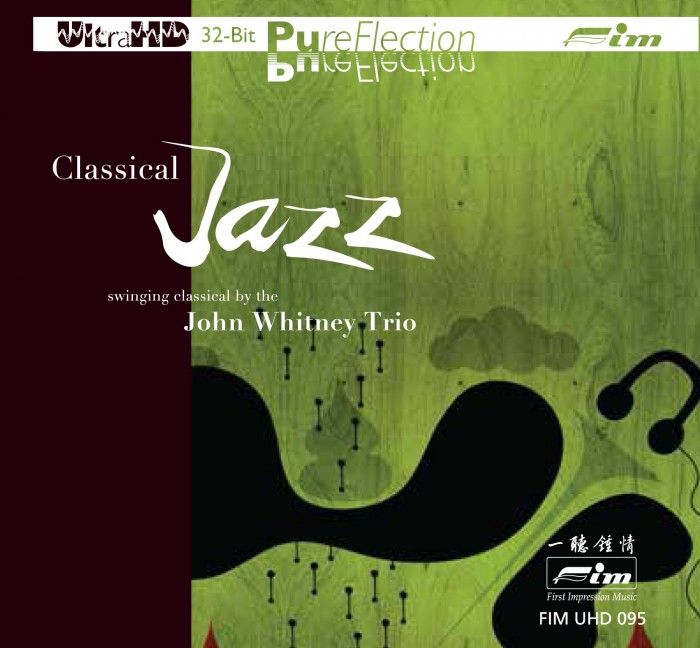
John Whitney Trio Classical Jazz – Swinging Classical Album
45,00 €
Classical Jazz – Swinging Classical is a John Whitney Trio music album for listeners interested in the meeting point between classical music and jazz. Its ten-track programme draws on references to Mozart, Schubert, Bizet, Ravel, Grieg, Weinberger, Chopin, Borodin, Tchaikovsky and Rachmaninoff. The sequence of different composers offers a broad field of classical themes within a unified trio concept.
Classical Jazz – Swinging Classical by the John Whitney Trio is a music album for listeners interested in the meeting point between classical music and jazz. The John Whitney Trio Classical Jazz programme consists of ten tracks, with each title linked to a different composer.
The programme includes references to Mozart, Schubert, Bizet, Ravel, Grieg, Weinberger, Chopin, Borodin, Tchaikovsky and Rachmaninoff. This selection brings references to different periods and traditions of classical music together on one album. The connecting thread is the John Whitney Trio and the central idea behind Swinging Classical.
Who is this album for?
This release is suited to listeners looking for something other than a conventional programme devoted to a single composer. Every track points towards a different figure from classical music. As a result, the album offers a broader range of references while retaining a consistent trio concept from beginning to end.
The collection may also appeal to listeners who already know classical themes and would like to encounter them in a different repertoire context. Titles such as “Funky George,” “Hip-Hop Night,” “Pete’s Blues” and “Two Grooves” clearly signal some of the programme’s more contemporary directions. These titles are paired respectively with the names of Bizet, Borodin, Tchaikovsky and Rachmaninoff, highlighting the dialogue between classical references and a more modern musical vocabulary.
How the programme is structured
The album opens with “Elvira (Mozart).” It is followed by “Theme from The Trout (Schubert),” which points to a theme from The Trout associated with Schubert. Together, these opening tracks immediately establish the programme’s main principle: references to the classical repertoire are connected with the John Whitney Trio’s individual track titles.
The third track, “Funky George (Bizet),” turns the programme towards Bizet. The fourth, “Pavamba (Ravel),” is linked to Ravel, while the fifth, “Killer Morning (Grieg),” refers to Grieg. The first half of the programme therefore moves through five different composers without repeating any of them. This gives each track its own classical point of reference while maintaining the album’s broader theme.
The second half begins with “Fantasy on Schwanda (Weinberger).” This is followed by “Waltz Evening (Chopin),” whose title directly indicates both a waltz direction and a connection with Chopin. “Hip-Hop Night (Borodin)” then brings Borodin’s name together with a different musical term, continuing the album’s pattern of combining classical associations with titles drawn from a wider vocabulary.
The programme concludes with “Pete’s Blues (Tchaikovsky)” and “Two Grooves (Rachmaninoff).” Their titles introduce the ideas of blues and rhythmic grooves. Through this sequence, the closing section makes the relationship between references to classical composers and the language of jazz especially apparent.
Ways to listen
The ten-track programme is arranged as a continuous journey through a series of different composers. It can be heard in sequence, starting with the first track and continuing through to the last. Listening this way allows the progression from references to Mozart and Schubert through to Tchaikovsky and Rachmaninoff to emerge most clearly.
Another approach is to begin with a familiar composer. This makes it easier to compare the expectation created by the track title and composer reference with the album concept presented by the John Whitney Trio. As each composer is represented by one track, no single classical figure dominates the programme.
The English-language track titles also distinguish these recordings from a conventional list of classical works. This is an important consideration when choosing the release: the album presents a themed trio programme rather than a standard catalogue of classical compositions. The composer names serve as points of reference within the concept, while the individual titles give every selection its own identity.
Track listing
- Elvira (Mozart)
- Theme from The Trout (Schubert)
- Funky George (Bizet)
- Pavamba (Ravel)
- Killer Morning (Grieg)
- Fantasy on Schwanda (Weinberger)
- Waltz Evening (Chopin)
- Hip-Hop Night (Borodin)
- Pete’s Blues (Tchaikovsky)
- Two Grooves (Rachmaninoff)
Technical specifications
| Album title | Classical Jazz – Swinging Classical |
|---|---|
| Artist | John Whitney Trio |
| Product type | Music album |
| Programme length | 10 tracks |
| Track 1 | Elvira (Mozart) |
| Track 2 | Theme from The Trout (Schubert) |
| Track 3 | Funky George (Bizet) |
| Track 4 | Pavamba (Ravel) |
| Track 5 | Killer Morning (Grieg) |
| Track 6 | Fantasy on Schwanda (Weinberger) |
| Track 7 | Waltz Evening (Chopin) |
| Track 8 | Hip-Hop Night (Borodin) |
| Track 9 | Pete’s Blues (Tchaikovsky) |
| Track 10 | Two Grooves (Rachmaninoff) |
FAQ
What kind of listener is this album intended for?
It is intended for listeners interested in the intersection of classical music and jazz. The programme is particularly relevant to anyone who would like to find references to ten different composers within a single album.
Is this a programme of works by one composer?
No. Each of the ten tracks is associated with a different composer. The list begins with Mozart and concludes with Rachmaninoff.
Are the tracks presented as a traditional classical recital?
The album title and individual track names indicate a meeting of classical and jazz themes. This is a John Whitney Trio programme, not a collection devoted to the works of one classical composer.
Which track is the best place to start listening?
To hear the complete progression of the programme, begin with “Elvira.” A listener looking for a familiar composer can instead select the corresponding track from the list.
Which musical terms appear in the track titles?
The titles refer to waltz, hip-hop, blues and grooves. These terms are linked with Chopin, Borodin, Tchaikovsky and Rachmaninoff respectively.
Are any composers repeated in the programme?
No. The ten positions name ten different composers, giving the programme a broad range of classical music references.
Is “Theme from The Trout” the complete Schubert work?
The title refers to a theme from The Trout, which is associated with Schubert. In the track listing, it is presented as the album’s separate second track.
![Patricia Barber Café Blue [Un-Mastered] jazz album](https://audiocentras.lt/wp-content/uploads/2026/09/patricia-barber-cafe-blue-un-mastered-1-300x300.jpg)