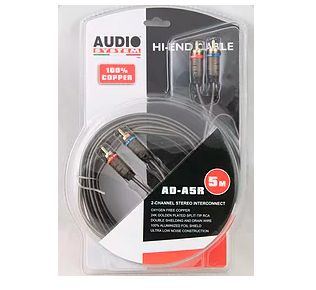
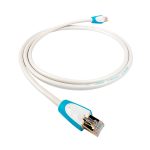
Audio System AD D5 RCA Cable
39,00 €
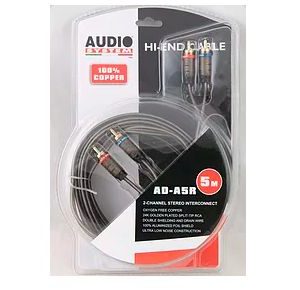
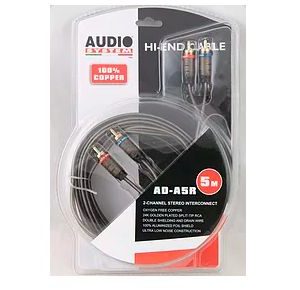
The Audio System AD D5 is a 5-metre RCA cable for line-level connections in car audio systems. Its conductor is made from 100% oxygen-free copper. Quadruple shielding reduces the effect of interference from nearby electrical circuits on the analogue signal. The cable is made in Italy.
The Audio System AD D5 RCA cable is a 5-metre analogue audio cable designed for car audio equipment with RCA connections. Its conductor is made from 100% oxygen-free copper, while quadruple shielding helps limit the effect of external interference. The cable is made in Italy.
Purpose in an audio system
This cable carries a line-level analogue audio signal between devices equipped with RCA connections. In a car, this type of connection is commonly used to connect an audio source, processor or amplifier.
An RCA cable is not a speaker cable or power cable. It connects line-level RCA outputs to the corresponding RCA inputs. Both connected devices must therefore have connections intended for this type of signal.
Choosing a five-metre cable
The 5-metre length is suitable for installations where audio components are fitted in different parts of the vehicle. A cable of this length may be required between the front console and an amplifier installed in the boot.
Before installation, measure the entire planned cable route rather than the straight-line distance between the devices. Allow for door sills, trim panels, bends and enough slack near the connectors. The cable should not be pulled tight or bent sharply.
Arrange any excess cable loosely and neatly. Do not trap it beneath mounting hardware or seat mechanisms. This helps prevent unnecessary mechanical strain during everyday vehicle use.
Copper conductor
The conductor is made from oxygen-free copper (OFC). The stated 100% copper composition means that the conductor material is not copper-clad aluminium. This is an important distinction when comparing cables by conductor material.
The copper composition does not change the connection procedure. Reliable operation still requires a secure contact at both ends. Insert the plugs straight, avoid moving them from side to side and never disconnect them by pulling on the cable itself.
Quadruple shielding
Quadruple shielding is intended to reduce the influence of interference generated by nearby electrical circuits on the analogue signal. This is particularly relevant inside a vehicle, where power, control and audio circuits operate within the same limited space.
Shielding is not a substitute for a properly planned cable route. Whenever possible, route the RCA cable separately from the amplifier power cable. Avoiding long parallel runs across the vehicle reduces the opportunity for interference to reach the signal cable.
If the cables have to cross, it is better for them to do so at as close to a right angle as possible. This shortens the section over which the signal cable remains close to the power circuit.
Connection and initial checks
Switch off the audio system before making any connections. Connect the RCA plugs to the corresponding line-level inputs and outputs. Do not use force if a plug does not align correctly with a socket.
After switching the system on, begin at a low volume. Check that sound is transmitted consistently through every connected channel. If you hear humming, inspect the connections and the cable route first.
Volume, filters, phase and other settings are adjusted on the connected equipment. The cable has no controls of its own; its function is to carry the analogue audio signal.
Planning the installation
Plan the route before removing the vehicle trim. Choose a path where the cable will not be crushed, rubbed or exposed to moving mechanisms. Pay particular attention to door-sill areas and seat mounting points.
Leave a short amount of free cable near each device. This makes it possible to pull out a component without placing tension on the connected lead. Insufficient slack puts strain on the sockets and makes later system maintenance more difficult.
Do not route the RCA cable where sharp metal edges could damage it. If the route must pass through such an area, protect the cable with a suitable automotive installation product.
Technical specifications
| Model | Audio System AD-D5 |
|---|---|
| Product type | RCA analogue audio cable |
| Length | 5 m |
| Connector type | RCA |
| Conductor material | Oxygen-free copper (OFC) |
| Copper content | 100% copper |
| Shielding | Quadruple |
| Country of manufacture | Italy |
FAQ
What is this RCA cable designed for?
It is designed to carry a line-level analogue signal between audio devices with RCA connections. In a vehicle, it can connect compatible audio sources, processors or amplifiers.
How can I determine whether the cable is long enough?
Measure the actual route through the vehicle trim and along the door sills. Add a small amount of slack for bends and connections, but avoid leaving a large coil of unused cable.
Can the cable be routed next to a power cable?
It is recommended that signal and power cables be routed separately. Quadruple shielding reduces the effect of interference, but careful routing remains important.
Is this a speaker cable?
No. This model carries a line-level signal through RCA connections. Different types of cable are required for speakers and amplifier power.
Is it suitable for a home stereo or home cinema system?
The model is intended for car audio equipment. RCA signal transmission may also be possible between other devices if their connections and intended signal type match.
Does the cable control volume or frequency filters?
No. Volume, filters, phase and channel settings are controlled by the audio source, processor or amplifier. The cable only carries the analogue signal.
What should I check if I hear humming after installation?
Check that the plugs are firmly inserted and that the cable is not damaged. Also inspect its route and separate it from power cables.